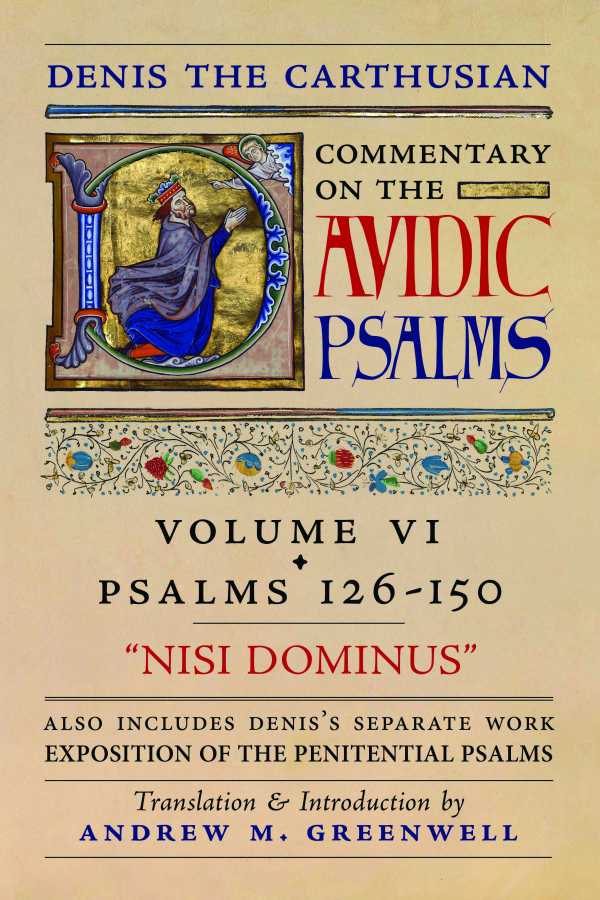
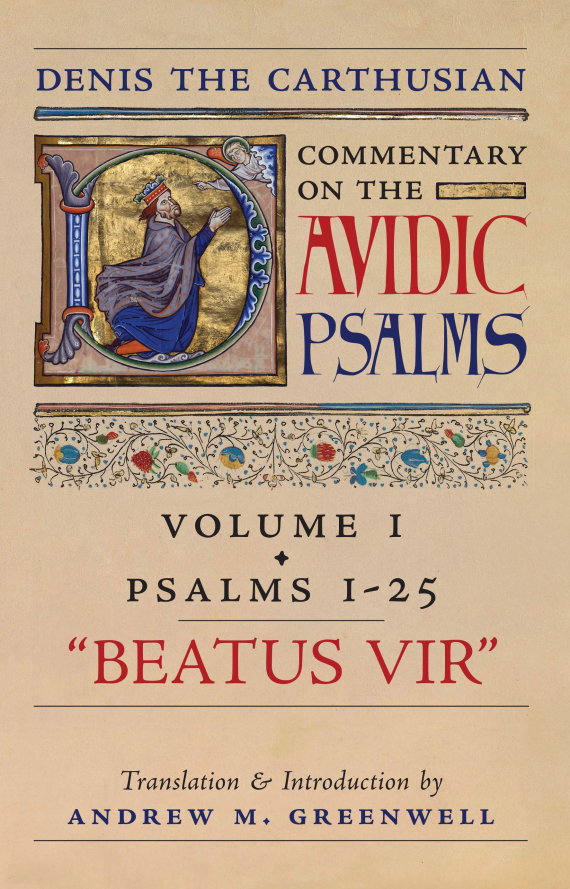
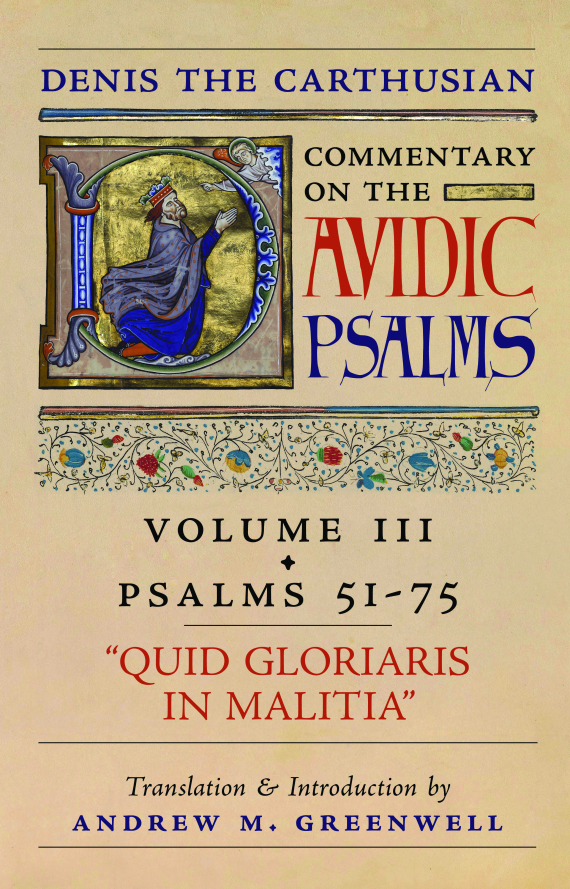
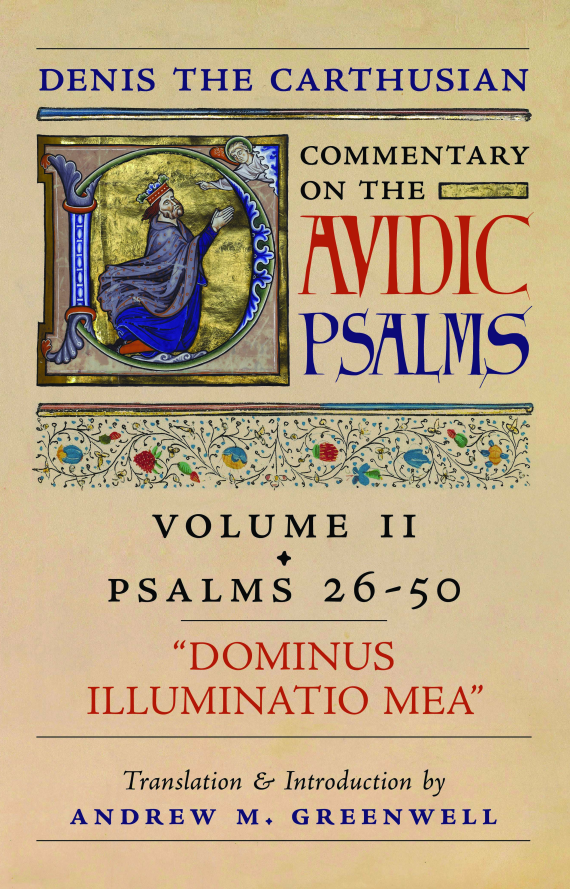
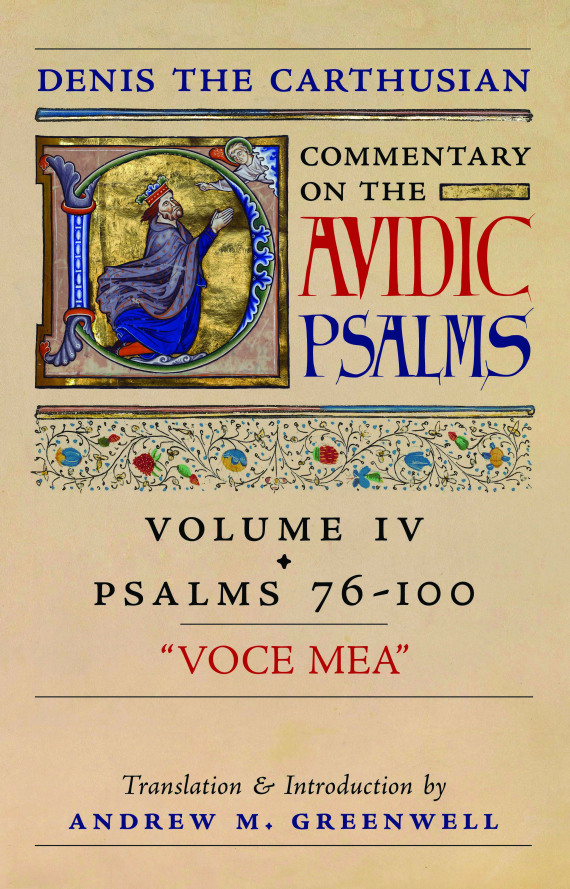
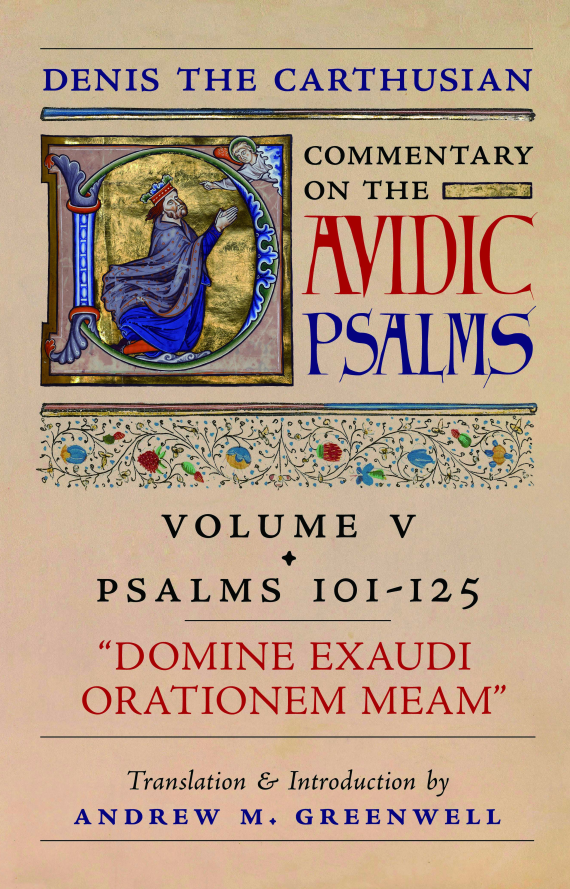
Denis the Carthusian · Commentary on the Davidic Psalms · Volume VI
✠ ❦ ✠
Nisi Dominus
Commentary on the Davidic Psalms
Volume VI · Psalms 126–150
Denis the Carthusian
Translation & Introduction by Andrew M. Greenwell
❦
“Read the entire Psalter.”
— St. Jerome
Nisi Dominus is the sixth and final volume of Denis the Carthusian’s (1402–1471) monumental Commentary on the Psalms, completing the English translation of his exposition of the Davidic Psalter. This volume contains Denis’s commentary on Psalms 126 through 150.
Denis the Carthusian, known to posterity as the Doctor Ecstaticus, stands near the culmination of the medieval exegetical tradition. His commentary gathers together the great inheritance of patristic and medieval interpretation while bearing the distinctive marks of his Thomistic education and his contemplative Carthusian vocation.
For Denis, however, the Psalms are never merely texts to be explained. They are to be prayed, interiorized, and lived. Their words instruct the mind, govern the affections, awaken compunction, strengthen virtue, and lead the Christian soul toward contemplation and union with God.
The Medieval Exegetical Tradition
Scripture in its multiple senses
Denis explains the Psalms according to the traditional interpretative inheritance of the Church. The historical or literal sense remains the foundation, while the spiritual senses disclose Christ, the Christian moral life, and the soul’s final destiny.
I
Literal
The historical and textual meaning that forms the necessary foundation of the Psalm’s interpretation.
II
Allegorical
The mysteries of Christ, His Church, and the economy of salvation signified in the sacred text.
III
Tropological
The moral sense by which the Psalm instructs and forms the Christian in virtue and the imitation of Christ.
IV
Anagogical
The eschatological sense directing the soul toward heavenly realities and its ultimate union with God.
✠
Hearing the Voice of Christ in the Psalms
The dominant weight in Denis’s interpretation is Christological. Although he recognizes the Psalter’s Jewish pedigree, historical context, and the voice of David, Denis continually looks beyond the sign to the reality signified. David is for him preeminently “the Prophet,” because through the Psalms the mystery of Christ is proclaimed with extraordinary fullness.
Within the Psalter Denis hears not simply the vox David, the voice of David, but above it the vox Christi: the voice concerning Christ, the voice of Christ to the Father, and the voice of Christ addressed to us.
vox David vox Christi vox Christi ad Patrem vox Christi ad nos vox de Christo
Denis’s Scriptural Method
Scripture explaining Scripture
Denis deliberately avoided an excessively elaborate scholastic apparatus in this commentary. Instead, his purpose was to explain the Psalms, “to the degree able,” with the most sound Scriptures of both Testaments.
Scriptura ex Scriptura explicanda est.
Scripture is to be explained through Scripture.
Yet his method remains unmistakably shaped by St. Thomas Aquinas. Denis entered the via Thomae during his studies at the University of Cologne and carried that intellectual formation into the Charterhouse at Roermond.
Thomistic
The theological architecture of St. Thomas frequently stands behind Denis’s interpretation, guiding his exegesis even when Aquinas is not explicitly cited.
Carthusian
Denis’s monastic vocation gives his theology its deeply contemplative character, drawing doctrine toward prayer, purification of heart, and the vision of God.
More Than Commentary
The Psalms are to be lived and prayed
Denis places a strong emphasis upon Christian practice. The Psalms are intended to school the Christian in a manner of living—the conversatio or imitatio Christi. His individual commentaries repeatedly move from exposition toward application, often ending with a peroration calling the reader to embody the Psalm’s teaching.
Each Psalm also concludes with prayer. Exegesis therefore does not terminate in understanding alone: understanding turns toward petition, conversion, virtue, and the grace necessary to put the sacred text into practice.
From interpretation to prayer
Denis’s Commentary moves repeatedly from the meaning of the Psalm to the moral and spiritual transformation of the person praying it.
❦
Tractate on the Method of Devoutly Reciting the Psalms
The Commentary on the Psalms fittingly concludes with a seven-article Tractate devoted to the practical and interior use of the Psalter in the Christian life.
Its concern is not simply how the Psalms are pronounced but how they are interiorized. The person praying the Psalms must learn how to order and vary his affects, concepts, intentions, and considerations according to the sacred text—in short, to form himself according to the mind of the Psalms, which is the mind of Christ.
The Interior Life
The affects of the heart
Denis focuses especially upon the affects—the emotive states, conditions, moods, inclinations, desires, and longings of the heart supportive of the theological virtues of faith, hope, and charity. These interior movements are to be enkindled and inflamed by the proper recitation of the Psalms.
Faith · Hope · Charity
The expressions of the heart themselves become material for prayer.
The Spiritual Ascent
Purgative · Illuminative · Unitive
The Psalms, Denis teaches, accompany the Christian throughout the traditional stages of the spiritual life. The same Psalter follows the soul as it is purified, illuminated, and finally drawn toward contemplative union with God.
I
The Purgative Way
The Psalms awaken compunction, expose sin, teach repentance, and assist the examination and purification of the heart.
II
The Illuminative Way
They instruct the soul in virtue, strengthen moral progress, and illuminate the Christian path toward perfection.
III
The Unitive Way
The Psalms enkindle charity and longing for God, preparing the purified soul for contemplation and mystical union.
Compunction and Self-Knowledge
The Gregorian scrutinies
Drawing upon Pope St. Gregory the Great, Denis identifies four objects of compunction through which the disciple of Christ examines himself before God. The Psalter thereby becomes an instrument not merely of praise but also of conscience, repentance, and interior conversion.
ubi fuit
Where has one been?
ubi erit
Where shall one be?
ubi non est
Where is one not?
A Separate Work Included
Exposition of the Seven Penitential Psalms
As an added boon, this volume contains Denis’s separate Exposition of the Seven Penitential Psalms, a work written at the request of Prospero Cardinal Colonna (ca. 1410–1463).
This is an independent work rather than a repetition of Denis’s treatment of these Psalms throughout the six-volume Commentary. Its method also differs somewhat from that of the principal work, drawing more extensively upon the patristic and medieval exegetical tradition.
✠ The Seven Psalms of Penance
Denis draws upon authorities including St. Jerome, St. Augustine, Pope St. Gregory the Great, St. John Chrysostom, St. Bernard of Clairvaux, St. Albert the Great, and St. Thomas Aquinas.
Psalms 6 · 31 · 37 · 50 · 101 · 129 · 142
The Seven Penitential Psalms had long occupied a privileged place in Christian devotion, particularly during the penitential seasons and in preparation for or thanksgiving after Confession. Denis relates them to the interior purification of the Christian and to the ordered ascent toward the pure and contemplative life.
Volume VI · The Final Volume
The Completion of the Commentary on the Psalms
With Psalms 126–150, the concluding Tractate on devout recitation, and the separate Exposition of the Seven Penitential Psalms, Nisi Dominus brings Andrew M. Greenwell’s six-volume English translation of Denis the Carthusian’s great commentary on the Psalter to its completion.
About the Translator
Andrew M. Greenwell
Andrew M. Greenwell is a married Catholic layman, with three children and thirteen grandchildren. He is a civil trial and appellate lawyer based in Corpus Christi, Texas. He has written articles for Catholic Online and for a number of years wrote a blog on the natural moral law called Lex Christianorum.
Edition
Book Details
Title
Nisi Dominus
Series
Commentary on the Davidic Psalms · Volume VI
Contents
Psalms 126–150
Author
Denis the Carthusian (1402–1471)
Translation & Introduction
Andrew M. Greenwell
Publication Date
September 12, 2026
Pages
460
Trim Size
6 × 9 inches
Paperback ISBN
978-1-998492-86-2
Hardcover ISBN
978-1-998492-87-9
✠ ❦ ✠
The Psalter interpreted according to Christ, formed into prayer, and carried into the interior life of the Christian.