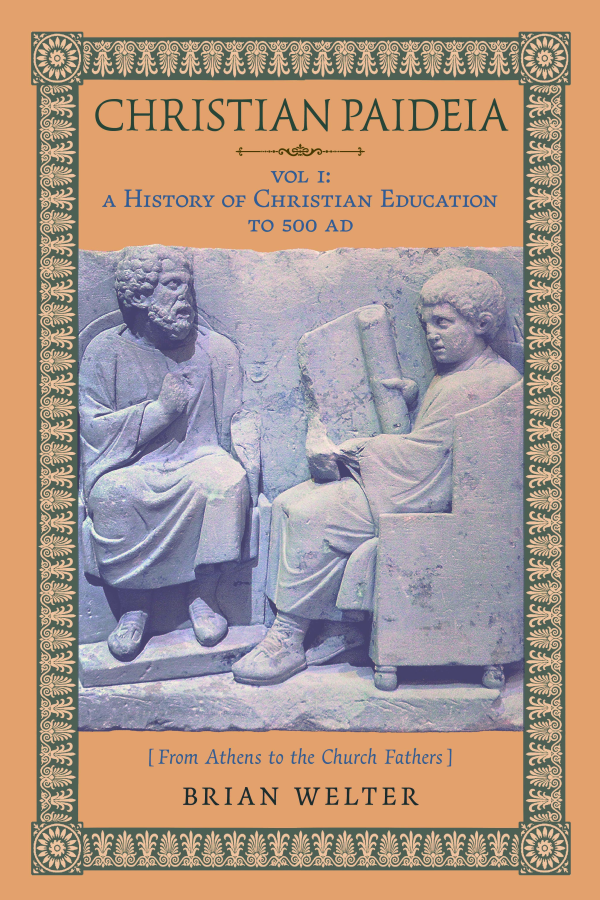

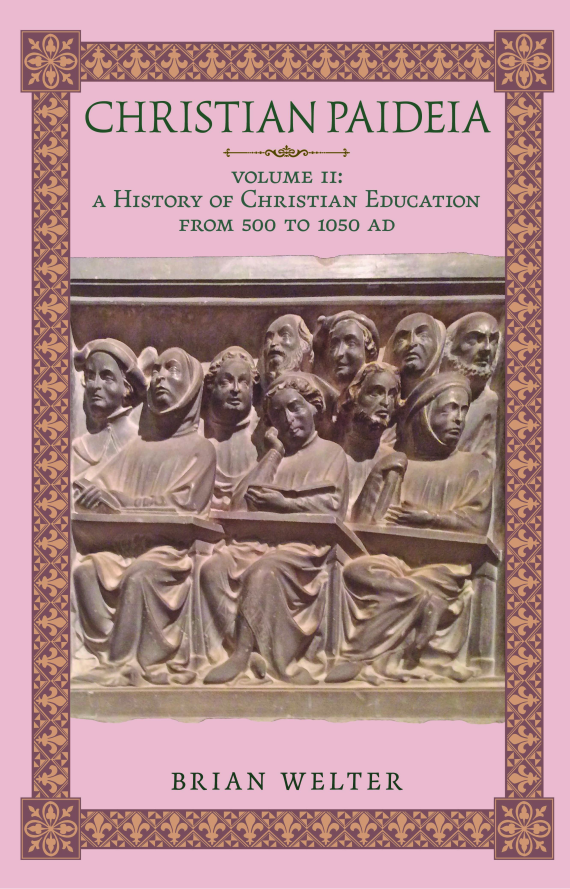
Christian Paideia (Vol. I: A History of Christian Education to 500 AD)

by Brian Welter
   0 reviews
  • Product Code: cpv1
  • Publication date: Early February 2025
  • Pages: 324
  • Size: 6 x 9
  • $24.95

Available on
amazon.com
Buy it at
B&N


  • Volume I of Brian Welter’s Christian Paideia

    Christian Paideia

    Volume I: A History of Christian Education to 500 AD

    From Athens to the Church Fathers


    A serious history of how the Church received, purified, and transfigured the ancient ideal of education—Greek paideia, Roman rhetoric, Scripture, catechesis, the Fathers, and the liberal arts—into a Christian formation of the whole person in truth.

    324 pages 6 × 9 Paperback & Hardback Arouca Press Christian education
     
    ✠ OVERVIEW ✠

    Vol. I: A History of Christian Education to 500 AD

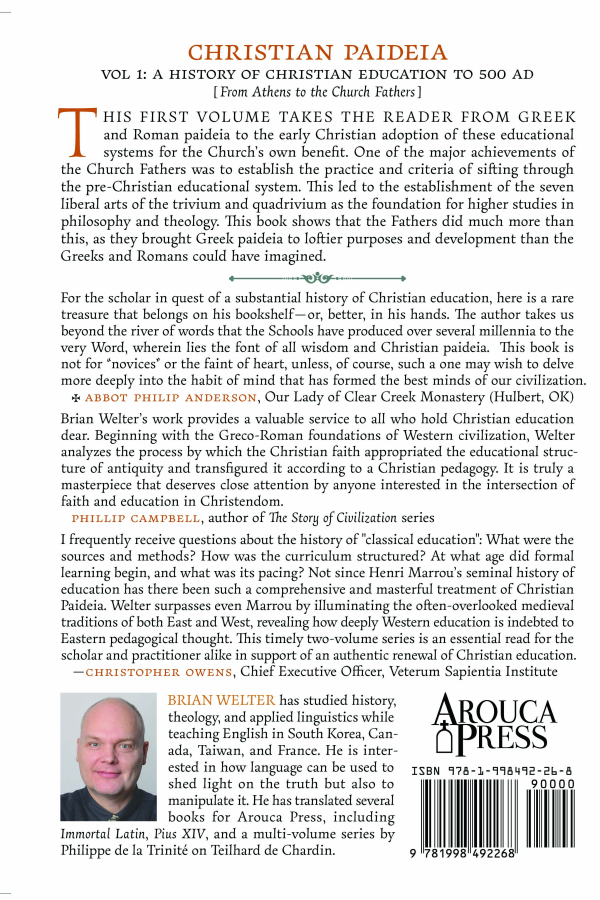
    This first volume takes the reader from Greek and Roman paideia to the early Christian adoption of these educational systems for the Church’s own benefit. One of the major achievements of the Church Fathers was to establish the practice and criteria of sifting through the pre-Christian educational system. This led to the establishment of the seven liberal arts of the trivium and quadrivium as the foundation for higher studies in philosophy and theology.

    This book shows that the Fathers did much more than this, as they brought Greek paideia to loftier purposes and development than the Greeks and Romans could have imagined.

    Here Christian education appears not as a modern method or administrative technique, but as a long spiritual and intellectual inheritance: a formation in truth, language, memory, virtue, worship, wisdom, and the contemplation of God.

    The first half of a larger history

    Volume I follows the passage from Athens and Rome into the life of the Church: the classical inheritance judged by the Gospel, reoriented by the Fathers, and ordered toward Christ the Logos.

    Athens received

    The volume begins with Greek paideia, virtue education, music, Plato, Aristotle, and the search for truth.

    Rome transformed

    Latin writers, rhetoric, Scripture, and the liturgy become material for a new Christian culture.

    The Fathers

    Clement, Origen, Basil, Gregory Nazianzus, Chrysostom, Jerome, Augustine, and others appear as teachers of Christian paideia.

    Liberal arts

    The trivium and quadrivium are treated as more than subjects: they are ordered paths toward wisdom.

     
    ❦ FROM VOLUME I ❦

    Christian education aims for the conversion of the individual sinner and the entire world to Christ.

    Chapter 1

    The Church’s confidence in the existence and capability of knowing the truth is the inspiration for the primary task of Christian education.

    Chapter 1

    The ancient Christians embraced Hellenic pedagogical and philosophical thought because they shared the Greek idea that truth, excellence, and beauty encouraged the development of the soul.

    Chapter 1

    We need to reach back to the riches of true western culture and turn away from the nonsensical, satanic culture that presently claims to be western.

    Preface for Volume 1

    A guiding principle

    Education is integral to the mission of the Church to proclaim the Good News. First and foremost every Catholic educational institution is a place to encounter the living God who in Jesus Christ reveals his transforming love and truth.

    —Pope Benedict XVI, Washington, April 17, 2008

     
    ✦ REVIEWED IN THE POSTIL ✦

    Review

    Jason Morgan on Christian Paideia

    The Postil Magazine · October 1, 2025


    Morgan calls the book a “formidable achievement” and an “essential read.”

    In his review, Jason Morgan presents Volume I as a learned, accessible account of one of the decisive cultural encounters in Christian history: the meeting of classical Greco-Roman education with the life, doctrine, worship, and mission of the early Church.

    He especially praises the book’s synthetic range: its treatment of Hellenistic paideia, St. Paul, the apologists, Clement, Origen, the Cappadocians, monastic formation, and Augustine’s mature vision of Christian learning.

    Morgan also notes that the volume avoids a simplistic triumphal narrative, attending to tensions within early Christian thought, including the more cautious or critical approaches to pagan learning.

    Read the full review

     
    ✦ THE ROUTE THROUGH VOLUME I ✦

    Athens

    Greek paideia, Plato, Aristotle, virtue education, and music.

    Jerusalem and Rome

    Latin writers, Scripture, the New Testament, and the making of a new Latin Christian culture.

    Alexandria

    Gnosticism, Neoplatonism, Clement, Origen, allegory, catechesis, and Christian culture.

    The Fathers

    The Cappadocians, St. Anthony, St. John Chrysostom, St. Jerome, and Augustine.

    The liberal arts

    The trivium, quadrivium, order, teaching, doctrine, poetry, Cassiodorus, and St. Benedict.

     
    ❦ KEY QUESTIONS FOR READERS ❦

    How did Greek paideia prepare the intellectual soil in which Christian education would take root?

    What did the Church Fathers accept, purify, and reject from pre-Christian educational culture?

    Why were the trivium and quadrivium foundational for later studies in philosophy and theology?

    How did catechesis, Scripture, liturgy, music, and memory form not only students, but Christian culture itself?

    What does Augustine teach about order, reason, teaching, doctrine, and the interior encounter with truth?

    Can modern Christian education recover its full scope as an education in wisdom, virtue, contemplation, and culture?

     
    ✦ BOOK DETAILS ✦

    Title

    Christian Paideia, Volume I

    Author

    Brian Welter

    Publication date

    Early February 2025

    Pages / Size

    324 pages · 6 × 9

    Paperback ISBN

    978-1-998492-26-8

    Hardback ISBN

    978-1-998492-27-5

    For the renewal of Christian education


    For readers who want to understand Christian education at its roots: not as a slogan, but as the Church’s long labor to form the mind, imagination, speech, memory, and moral life according to Christ.

  • Brian Welter

    Author · Translator · Teacher

    Brian Welter

    History, theology, language, and the search for truth


    A general author and translator page for Brian Welter’s work with Arouca Press: original studies and translations.

    Christian education Translation History Theology Applied linguistics
     
    ✠ ABOUT THE AUTHOR ✠

    Brian Welter has studied history, theology, and applied linguistics while teaching English in South Korea, Canada, Taiwan, and France. He is interested in how language can be used to shed light on the truth but also to manipulate it. He has translated several books for Arouca Press, including Immortal Latin, Pius XIV, and Philippe de la Trinité’s three-volume set, Teilhard de Chardin: A Critical Study, which is a work in progress.

    Language and truth

    Welter’s work is marked by a concern for words: how language can disclose reality, preserve Christian memory, form the mind, and also become a tool of distortion when severed from truth.

     
    ❦ ORIGINAL WORKS ❦

    Welter is the author of Arouca Press’s two-volume Christian Paideia, a substantial history of Christian education from classical antiquity through the early Middle Ages.

    Authored work

    Christian Paideia, Vol. I

    A History of Christian Education to 500 AD: From Athens to the Church Fathers.

    Authored work

    Christian Paideia, Vol. II

    A History of Christian Education from 500 to 1050 AD.

    Two-volume set

    Christian Paideia Set

    Volumes I & II together: 622 pages of Christian educational history.

     
    ✦ TRANSLATIONS FOR AROUCA PRESS ✦

    Translation · Latin & civilization

    Immortal Latin

    Marie-Madeleine Martin’s defense of Latin’s civilizational and universal significance.

    Translation · fiction / ecclesial crisis

    Pius XIV

    Don Giuseppe Pace’s novel on the postconciliar crisis, tradition, and the drama of reform.

    Translation · theological critique

    Teilhard de Chardin: A Critical Study

    Philippe de la Trinité, o.c.d. The full three-volume set is a work in progress:

    Volume I: Faith in the Universal Christ
    Volume II: Cosmic and Christic Vision
    Volume III: For and Against Teilhard de Chardin, Religious Thinker

    Translation · Thomistic modernity critique

    Intelligence in Danger of Death

    Marcel De Corte’s analysis of propaganda, utopia, false information, and the crisis of intelligence.

    Translation · political philosophy

    Salazar and His Work

    Essays by Marcel De Corte, Pierre Gaxotte, and Gustave Thibon, with foreword by Dr. Marcos Pinho de Escobar.

    Translation · liberalism critique

    Either Catholicism or Liberalism

    The pastoral and circular letters of St. Ezequiel Moreno y Díaz.

     
    ✦ AREAS OF WORK ✦

    Christian education

    His authored work examines the inheritance of Christian learning and the history of formation in truth.

    Translation

    His translations bring French, Italian, and Spanish Catholic works into English for contemporary readers.

    History and theology

    His background in history and theology informs his approach to Christian culture and doctrine.

    Applied linguistics

    His interest in language includes both its capacity to reveal truth and its capacity to obscure or manipulate it.

    General author page


    This page serves as a common point of reference for Welter’s authored works and translations for Arouca Press.

  • Praise for Brian Welter’s Christian Paideia

    Endorsements for Christian Paideia

    Volume I: A History of Christian Education to 500 AD

    From Athens to the Church Fathers


    Scholars, educators, and Catholic writers commend Welter’s history as a rare and substantial recovery of Christian education in its ancient and patristic sources.

    Christian education Classical learning Patristic wisdom Faith and education Renewal of schools

    These endorsements present Christian Paideia as a major contribution to the renewal of Christian education: substantial, demanding, historically serious, and ordered to the Word in whom all wisdom finds its source.

    ancient education · the Church Fathers · East and West · classical curriculum · Christian wisdom

     
    ✠ ENDORSEMENTS ✠
    I

    For the scholar in quest of a substantial history of Christian education, here is a rare treasure that belongs on his bookshelf—or, better, in his hands.

    The author takes us beyond the river of words that the Schools have produced over several millennia to the very Word, wherein lies the font of all wisdom and Christian paideia.  This book is not for “novices” or the faint of heart, unless, of course, such a one may wish to delve more deeply into the habit of mind that has formed the best minds of our civilization.


    —✠ Abbot Philip Anderson
    Our Lady of Clear Creek Monastery (Hulbert, OK)

    II

    Brian Welter's work provides a valuable service to all who hold Christian education dear. Beginning with the Greco-Roman foundations of Western civilization, Welter analyzes the process by which the Christian faith appropriated the educational structure of antiquity and transfigured it according to a Christian pedagogy. It is truly a masterpiece that deserves close attention by anyone interested in the intersection of faith and education in Christendom.


    —Phillip Campbell
    author of The Story of Civilization series

    III

    I frequently receive questions about the history of “classical education”: What were the sources and methods? How was the curriculum structured? At what age did formal learning begin, and what was its pacing? Not since Henri Marrou’s seminal history of education has there been such a comprehensive and masterful treatment of Christian Paideia.

    Welter surpasses even Marrou by illuminating the often-overlooked medieval traditions of both East and West, revealing how deeply Western education is indebted to Eastern pedagogical thought. This timely two-volume series is an essential read for the scholar and practitioner alike in support of an authentic renewal of Christian education.


    —Christopher Owens
    Chief Executive Officer, Veterum Sapientia Institute

     
    ❦ WHAT THE PRAISE EMPHASIZES ❦

    Substantial history

    The book is praised as a rare, serious history for scholars and committed readers.

    Christian transformation

    Welter shows how the Church appropriated and transfigured classical education.

    Beyond Marrou

    Owens emphasizes the series’ breadth and its treatment of both East and West.

    For renewal

    The endorsements connect the book to the authentic renewal of Christian education today.

    For scholars, teachers, and serious readers


    The praise for Christian Paideia is unified by one point: this is not a fashionable treatment of education, but a work that returns the reader to the deepest sources of Christian learning.

Reviews (0)

   0 reviews

Be the first to write a review for this product.

You May Also Like

  • Christian Paideia (Vol. II: A History of Christian Education from 500 to 1050 AD)...

    Brian Welter

    *Please be aware that books will take longer to arrive during this time of year. Thank you for your understanding! ...

    View Book →
  • Christian Paideia set (Vols. 1 & 2)...

    Brian Welter

    ✠ ✠ ❦ ❦ A two-volume history of Christian education Christian Paideia Brian Welter   From...

    View Book →

    Stay in Touch

    Receive updates on new releases, special offers, and notable developments from Arouca Press.