
Christian Paideia (Vol. II: A History of Christian Education from 500 to 1050 AD)...
*Please be aware that books will take longer to arrive during this time of year. Thank you for your understanding! ...
View Book →


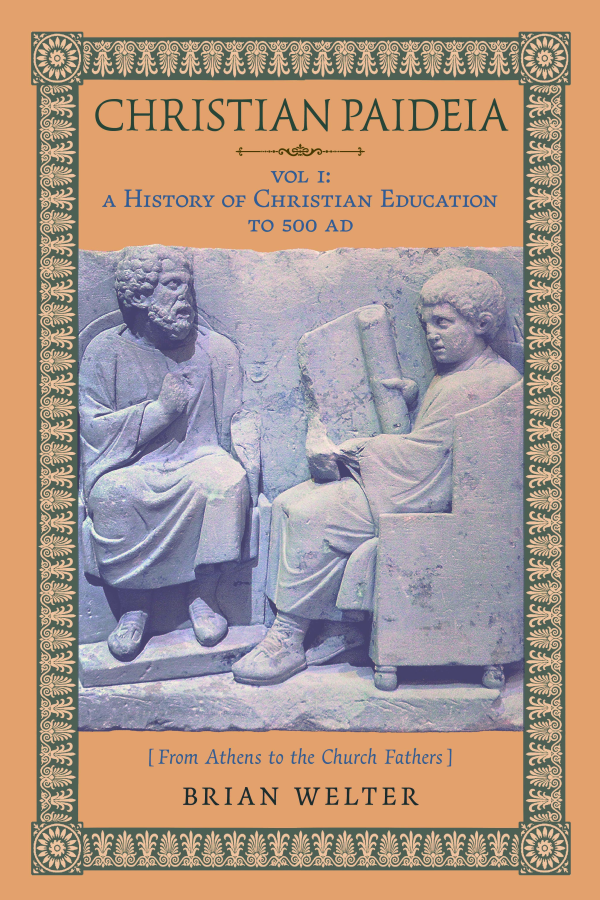
Vol. I: A History of Christian Education to 500 AD
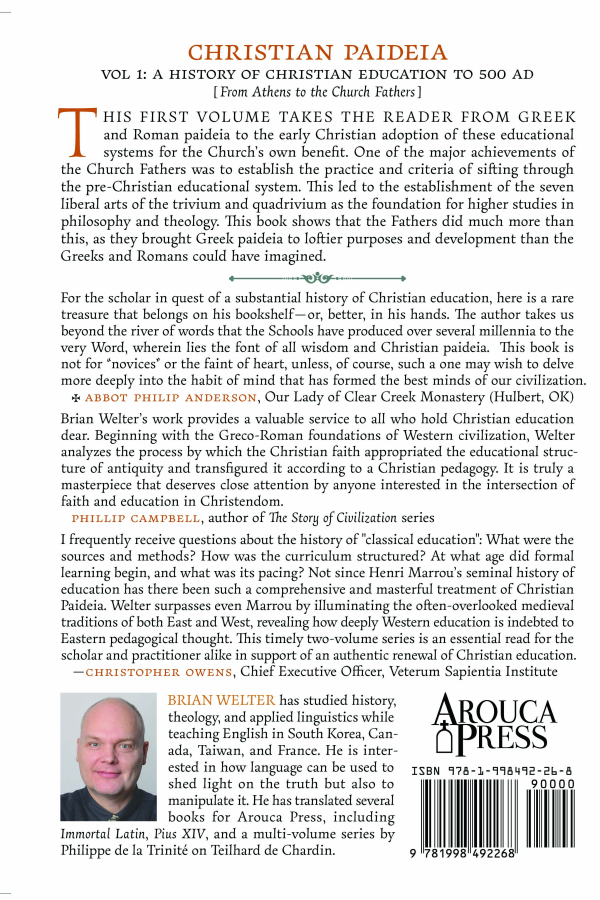
This first volume takes the reader from Greek and Roman paideia to the early Christian adoption of these educational systems for the Church’s own benefit. One of the major achievements of the Church Fathers was to establish the practice and criteria of sifting through the pre-Christian educational system. This led to the establishment of the seven liberal arts of the trivium and quadrivium as the foundation for higher studies in philosophy and theology.
This book shows that the Fathers did much more than this, as they brought Greek paideia to loftier purposes and development than the Greeks and Romans could have imagined.
Here Christian education appears not as a modern method or administrative technique, but as a long spiritual and intellectual inheritance: a formation in truth, language, memory, virtue, worship, wisdom, and the contemplation of God.
The first half of a larger history
Volume I follows the passage from Athens and Rome into the life of the Church: the classical inheritance judged by the Gospel, reoriented by the Fathers, and ordered toward Christ the Logos.
Athens received
The volume begins with Greek paideia, virtue education, music, Plato, Aristotle, and the search for truth.
Rome transformed
Latin writers, rhetoric, Scripture, and the liturgy become material for a new Christian culture.
The Fathers
Clement, Origen, Basil, Gregory Nazianzus, Chrysostom, Jerome, Augustine, and others appear as teachers of Christian paideia.
Liberal arts
The trivium and quadrivium are treated as more than subjects: they are ordered paths toward wisdom.
Christian education aims for the conversion of the individual sinner and the entire world to Christ.
Chapter 1
The Church’s confidence in the existence and capability of knowing the truth is the inspiration for the primary task of Christian education.
Chapter 1
The ancient Christians embraced Hellenic pedagogical and philosophical thought because they shared the Greek idea that truth, excellence, and beauty encouraged the development of the soul.
Chapter 1
We need to reach back to the riches of true western culture and turn away from the nonsensical, satanic culture that presently claims to be western.
Preface for Volume 1
A guiding principle
Education is integral to the mission of the Church to proclaim the Good News. First and foremost every Catholic educational institution is a place to encounter the living God who in Jesus Christ reveals his transforming love and truth.
—Pope Benedict XVI, Washington, April 17, 2008
Review
The Postil Magazine · October 1, 2025
Morgan calls the book a “formidable achievement” and an “essential read.”
In his review, Jason Morgan presents Volume I as a learned, accessible account of one of the decisive cultural encounters in Christian history: the meeting of classical Greco-Roman education with the life, doctrine, worship, and mission of the early Church.
He especially praises the book’s synthetic range: its treatment of Hellenistic paideia, St. Paul, the apologists, Clement, Origen, the Cappadocians, monastic formation, and Augustine’s mature vision of Christian learning.
Morgan also notes that the volume avoids a simplistic triumphal narrative, attending to tensions within early Christian thought, including the more cautious or critical approaches to pagan learning.
Athens
Greek paideia, Plato, Aristotle, virtue education, and music.
Jerusalem and Rome
Latin writers, Scripture, the New Testament, and the making of a new Latin Christian culture.
Alexandria
Gnosticism, Neoplatonism, Clement, Origen, allegory, catechesis, and Christian culture.
The Fathers
The Cappadocians, St. Anthony, St. John Chrysostom, St. Jerome, and Augustine.
The liberal arts
The trivium, quadrivium, order, teaching, doctrine, poetry, Cassiodorus, and St. Benedict.
How did Greek paideia prepare the intellectual soil in which Christian education would take root?
What did the Church Fathers accept, purify, and reject from pre-Christian educational culture?
Why were the trivium and quadrivium foundational for later studies in philosophy and theology?
How did catechesis, Scripture, liturgy, music, and memory form not only students, but Christian culture itself?
What does Augustine teach about order, reason, teaching, doctrine, and the interior encounter with truth?
Can modern Christian education recover its full scope as an education in wisdom, virtue, contemplation, and culture?
Title
Christian Paideia, Volume I
Author
Brian Welter
Publication date
Early February 2025
Pages / Size
324 pages · 6 × 9
Paperback ISBN
978-1-998492-26-8
Hardback ISBN
978-1-998492-27-5
These endorsements present Christian Paideia as a major contribution to the renewal of Christian education: substantial, demanding, historically serious, and ordered to the Word in whom all wisdom finds its source.
ancient education · the Church Fathers · East and West · classical curriculum · Christian wisdom
Substantial history
The book is praised as a rare, serious history for scholars and committed readers.
Christian transformation
Welter shows how the Church appropriated and transfigured classical education.
Beyond Marrou
Owens emphasizes the series’ breadth and its treatment of both East and West.
For renewal
The endorsements connect the book to the authentic renewal of Christian education today.
Be the first to write a review for this product.
*Please be aware that books will take longer to arrive during this time of year. Thank you for your understanding! ...
View Book →-570x889.png "Christian Paideia set (Vols. 1 & 2)")
✠ ✠ ❦ ❦ A two-volume history of Christian education Christian Paideia Brian Welter From...
View Book →
Receive updates on new releases, special offers, and notable developments from Arouca Press.