-600x900.png "Christian Paideia set (Vols. 1 & 2)")

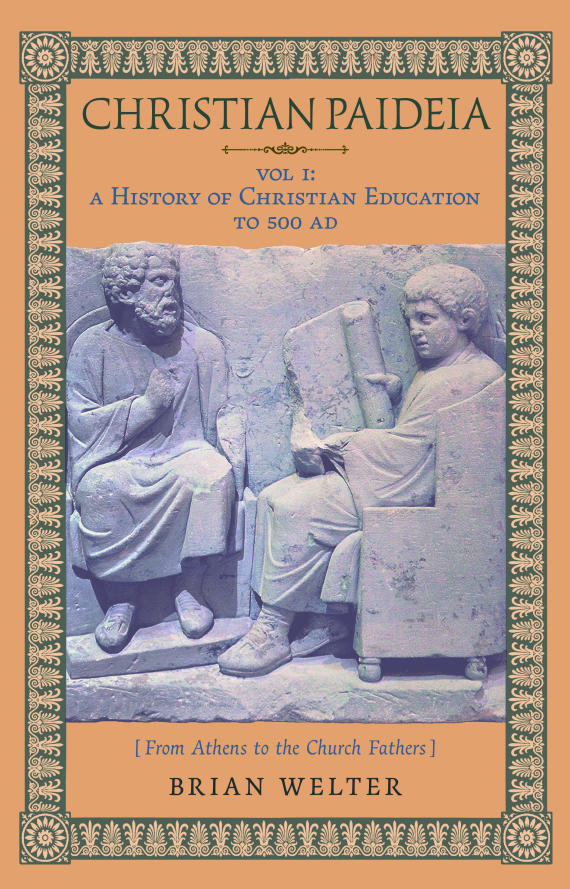
Christian Paideia (Vol. I: A History of Christian Education to 500 AD)...
✠ ✠ ❦ ❦ Volume I of Brian Welter’s Christian Paideia Christian Paideia Volume I: A History of Christ...
View Book →
Vol. I: A History of Christian Education to 500 AD (From Athens to the Church Fathers)
This first volume takes the reader from Greek and Roman paideia to the early Christian adoption of these educational systems for the Church’s own benefit. One of the major achievements of the Church Fathers was to establish the practice and criteria of sifting through the pre-Christian educational system. This led to the establishment of the seven liberal arts of the trivium and quadrivium as the foundation for higher studies in philosophy and theology.
This book shows that the Fathers did much more than this, as they brought Greek paideia to loftier purposes and development than the Greeks and Romans could have imagined.
Vol. II: A History of Christian Education from 500 to 1050 AD
While the first volume of Christian Paideia traces the outstanding achievements of the Church Fathers in their appropriation of Greco-Roman paideia for the Church, the second volume discusses how early medieval thinkers from the Latin West and the Greek East continued and deepened this work. They further developed many aspects of this now-Christian paideia and added much that was creative, spiritual, and even charming in their love and pursuit of wisdom and the truth.
They did so even while they faced a range of cultural, educational, and religious challenges in the upheavals that Western and Eastern Christians faced from 500 to 1050 AD.
Why this set matters
Christian education was never merely a technique for passing on information. It was a formation of the soul in truth, virtue, wisdom, language, worship, and culture.
Classical roots
See how Greek and Roman paideia became material for Christian formation.
The Fathers
Follow Clement, Origen, the Cappadocians, Jerome, Augustine, and others.
The liberal arts
Recover the trivium and quadrivium as paths toward wisdom and theology.
East & West
Understand how Latin and Greek Christian learning shared roots while developing distinct identities.
Christian education aims for the conversion of the individual sinner and the entire world to Christ.
Volume I
The Church’s confidence in the existence and capability of knowing the truth is the inspiration for the primary task of Christian education.
Volume I
This is the second of two volumes on how the Church appropriated Greek and Roman paideia, and developed it into Christian paideia.
Volume II
Christianity’s unique molding of pre-Christian paideia to fit its own needs brought the seven liberal arts to their apogee.
Volume II
Athens
Greek paideia, virtue, Plato, Aristotle, music, and the search for truth.
Rome
Latin writers, rhetoric, the Bible, and the formation of a new Christian culture.
The Fathers
Catechesis, exegesis, doctrine, Augustine, the liberal arts, and Christian wisdom.
The Monastery
Reading, chant, lectio divina, manuscript culture, and the education of saints.
The Renaissance
Irish, Anglo-Saxon, Carolingian, and Byzantine renewals of learning.
For Catholic educators
This set gives teachers, school leaders, homeschoolers, and parents a deeper account of what Christian education has meant historically: not a modern program, but a conversion of the mind and soul toward Christ.
For students of history
The work follows the long passage from classical antiquity into Christian culture, showing how the Church formed a civilization of books, schools, prayer, memory, music, argument, and contemplation.
Scholarship
A substantial history of Christian education.
Paideia
A recovery of education as Christian formation.
East & West
A fuller account of medieval pedagogical traditions.
Renewal
An essential read for scholars and practitioners.
Be the first to write a review for this product.
✠ ✠ ❦ ❦ Volume I of Brian Welter’s Christian Paideia Christian Paideia Volume I: A History of Christ...
View Book →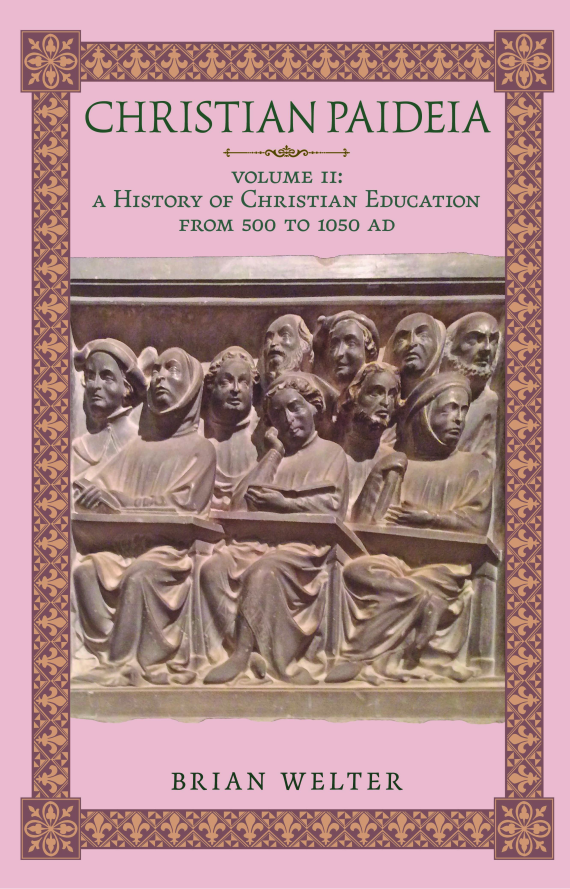
*Please be aware that books will take longer to arrive during this time of year. Thank you for your understanding! ...
View Book →
Receive updates on new releases, special offers, and notable developments from Arouca Press.