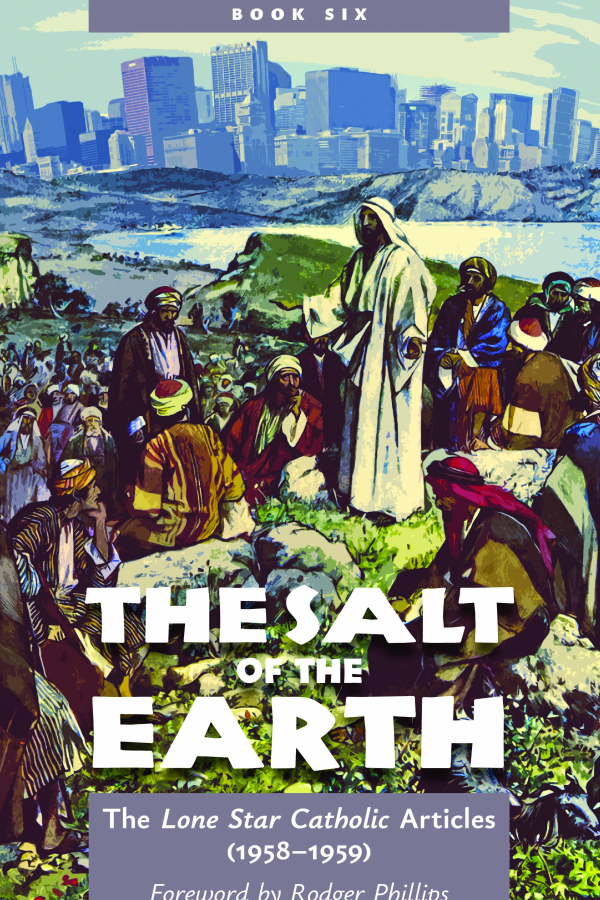
The Salt of the Earth: The Lone Star Articles (1958–1959) (Book 6/Collected Works)

by Carol Jackson Robinson
   0 reviews
  • Product Code: tsote
  • $16.95

Available on
amazon.com
Buy it at
B&N


  •  


    Carol Robinson’s Collected Works · Book Six

    The Salt of the Earth

    The Lone Star Catholic Articles (1958–1959)

    Foreword by Rodger Phillips


    A recovered collection of Robinson’s short, incisive columns on grace, society, Christian witness, and the modern world’s conspicuous absence of God.

    Lone Star Catholic 1958–1959 Lay Catholic witness Grace and society Paperback & hardcover

    These articles show Robinson writing at column length: quick, witty, and practical, but still governed by the same Catholic realism that marked her larger works. She looks at marriage, education, socialism, psychiatry, television, birth control, poverty, work, and culture, asking again and again what the world looks like when grace is no longer allowed to season it.

    natural goodness · social order · grace · authority · marriage · poverty · culture · Catholic realism

     
    ✠ OVERVIEW ✠

    The Salt of the Earth comprises all of the known articles Carol Robinson wrote for The Lone Star Catholic, the official newspaper of the Diocese of Austin, Texas. The founding editor, Dale Francis, invited Robinson to write a column, and she did so for one year, from April 1958 to April 1959.

    These pieces were written several years after Robinson’s intense work in Integrity. The articles are shorter and more occasional, but the mind is unmistakably the same: alert to secular assumptions, impatient with sentimentality, attentive to grace, and determined to measure modern life by the truth of the Catholic Faith.

    The title essay gives the volume its organizing image. Christians are not merely one pressure group among others, nor are they called to retreat into private piety. They are the salt of the earth because supernatural grace gives savor to temporal life and preserves society from decay.

    The central image

    Salt is small, hidden, and easily overlooked. Yet without it, what remains may be adequate, organized, and materially successful—while becoming tasteless, drab, and spiritually lifeless.

     
    ❦ FULL QUOTES FROM THE BOOK ❦

    “Naturally Good,” p. 5

    “It is much better to strengthen our faith with understanding, to see what God intends for this world of ours, to determine the relevance of Christianity to temporal affairs.”

    “The Salt of the Earth,” p. 8

    “The one thing which makes us different from other men is that we share God’s life by supernatural grace. This grace is our savor.”

    “Utopia,” p. 15

    “God’s plan is not for equality, or for guaranteed material well being, or for a surfeit of the good things of this earth. It is for men to become almost divine and to participate in God’s own life for all eternity.”

    “Water is Thicker Than Blood,” p. 26

    “They are now to be brothers of Christ and so of each other, branches of one vine, living by one same divine life. The most naturally diverse among them are to be brought closer to each other in charity, than to their own close blood relations in a human way.”

    “We Privileged Few,” p. 78

    “If Catholic scholars, or we ourselves, see human affairs exactly as non-believers see them, we are either weak in faith or bottling up our faith in narrow religious confines.”

    “Star of Wonder,” p. 115

    “The ultimate reason why anything at all exists outside of God is because God is Good, and goodness is self-diffusive.”

     
    ✦ WHY THIS VOLUME MATTERS ✦

    A Catholic social eye

    Robinson reads politics, domestic life, work, welfare, media, and education through the order of grace.

    A voice before the Council

    The columns were written on the eve of Vatican II, when many Catholics still hoped for a public renewal of Catholic life.

    Short columns, deep principles

    The essays are brief, but they repeatedly return to first principles: creation, grace, sin, authority, truth, and salvation.

    Recovered from the archives

    The pieces were retrieved from diocesan archives in Austin, Texas, and restored to Robinson’s collected works.

    ✠ ✧ ✠

    Robinson’s question is never merely “What is happening?” Her deeper question is: What happens to human life when natural goods are detached from grace, truth, and man’s supernatural end?

     
    ❦ THEMES INSIDE THE BOOK ❦

    Christianity and temporal life

    The opening columns examine how Christianity relates to psychiatry, social reform, technology, political organization, and the “new secular order.”

    The family and social order

    Robinson treats marriage, divorce, women’s work, children, education, and the home as places where grace either enters life or is excluded from it.

    Modern substitutes for grace

    Money, psychiatry, welfare bureaucracy, group techniques, public opinion, and consumer progress all appear as partial answers to spiritual disorder.

    Catholic confidence

    The book does not panic before the modern world; it asks Catholics to strengthen their faith with understanding and to act from first principles.

    The Catholic minority?

    Robinson resists the sociological reduction of Catholics to a “minority group,” insisting that the Church must be understood by revelation.

    The fixed point

    The final columns draw readers toward fidelity, authority, marriage, and Christ as the stable point by which human life regains direction.

     
    ✦ BOOK DETAILS ✦

    Title

    The Salt of the Earth

    Subtitle

    The Lone Star Catholic Articles (1958–1959)

    Author

    Carol Jackson Robinson

    Series

    Carol Robinson’s Collected Works · Book Six

    Paperback ISBN

    978-1-990685-89-7

    Hardcover ISBN

    978-1-990685-90-3

    The Catholic presence in the world


    Robinson’s columns remind the reader that Christian witness begins with savor: the hidden life of grace, acting through ordinary Catholics, giving temporal life its taste, direction, and final meaning.

  • Carol Jackson Robinson


    Arouca Press Author Page

    CJR

    Carol Jackson Robinson

    Catholic Writer · Editor · Lecturer · Lay Thomist

    May 5, 1911 – August 23, 2002


    A recovered Catholic voice of unusual force: clear, humorous, unsentimental, and deeply formed by the doctrine of St. Thomas Aquinas.

    Thomistic lay witness Integrity magazine Catholic Action Lay vocation Collected Works

    For many years, Carol Jackson Robinson’s books, articles, letters, and Integrity writings were scattered, difficult to obtain, and largely absent from Catholic memory. Arouca Press has undertaken the recovery of her complete works, restoring one of the most original and Thomistically grounded Catholic lay writers of the twentieth century to the readers who need her now.

    St. Thomas Aquinas · Catholic culture · the lay state · spiritual realism · postwar America

     
    ✠ BIOGRAPHY ✠

    Carol Jackson Robinson was an American Catholic writer, editor, lecturer, and public speaker. Born in Oshkosh, Wisconsin, and raised in West Redding, Connecticut, she studied at Wellesley College, passed for a time through atheism, and graduated in 1937. After attending a lecture on Catholic Action by Paul McGuire in New York City, she converted to the Catholic Faith in 1941.

    Her conversion gave lasting direction to her intellectual and literary life. Writing frequently under the pseudonym Peter Michaels, Robinson became known for her criticism of spiritual mediocrity, secular modernity, and the tendency to reduce Catholic life to private piety. Her work is marked by a fierce confidence that grace is real, that the lay vocation has its own dignity, and that Catholic intelligence must be formed by St. Thomas Aquinas.

    In 1946, together with artist and writer Ed Willock, she founded Integrity, one of the most distinctive Catholic journals of postwar America. The magazine gathered a circle of serious Catholic writers and thinkers and sought to articulate a complete Catholic life: doctrinal, cultural, social, liturgical, familial, and public. Robinson worked with Integrity until 1952.

    In 1956 she married Maurie Leigh Robinson, a former NBC writer. She later returned to formal study and received an M.A. in Theology from St. John’s University in Queens, New York, in 1967. In 1975, she received the Wanderer Award for her work in promoting the thought of St. Thomas Aquinas. From 1971 to 1987 she wrote more than sixty articles for The Wanderer, including a substantial six-part critique of Karl Rahner.

    The governing conviction

    Robinson wrote as a laywoman convinced that sanctity is not a clerical specialty, nor a monastic costume adopted by the laity, but the normal vocation of Catholics living in the real conditions of family, work, culture, and public life.

     
    ❦ A THOMISTIC MIND FOR THE MODERN CRISIS ❦

    St. Thomas as master

    Robinson’s essays consistently return to Thomistic clarity: nature and grace, virtue, the common good, the Beatitudes, and the lay vocation.

    Against mediocrity

    She attacked tepid Catholicism, anti-intellectual piety, and the surrender of Catholic life to Americanized habits of thought.

    The lay state

    Her famous criticism of “nunks” defended a properly lay holiness rooted in one’s real duties, not imitation of religious life.

    Cultural combat

    Her later work brought Thomistic judgment to bear on secular humanism, postconciliar confusion, and false theories of progress.

     
    ✦ THE CAROL JACKSON ROBINSON LIBRARY FROM AROUCA PRESS ✦

    Arouca Press has brought Carol Jackson Robinson’s writings back into print as a coherent library rather than as isolated reprints. The volumes below recover her major books, her essays on the Beatitudes and the lay vocation, her cultural criticism, and her later work on the postconciliar crisis.

    Main Collected Works Series

    The central sequence of Robinson’s recovered books and major essay collections.

    Volume I

    Breaking the Chains of Mediocrity

    Robinson’s bracing call to Catholic seriousness, spiritual maturity, and resistance to the habits of mediocrity.

    Volume II

    The Eightfold Kingdom Within

    Essays on the Beatitudes and the Gifts of the Holy Ghost, presenting Thomistic spiritual theology for ordinary Catholics.

    Volume III

    Designs for Christian Living

    A practical account of Christian life, culture, and the habits needed for a fully Catholic home and society.

    Volume IV

    This Perverse Generation

    A sharp critique of lukewarm Catholicism, modern culture, and the evasions by which Christians avoid conversion.

    Volume V

    Thy Faith Hath Made Thee Whole

    A substantial collection on Catholic wholeness, spiritual sanity, the Incarnation, and the healing of modern fragmentation.

    Volume VI

    The Salt of the Earth

    Robinson’s preconciliar essays on the Catholic vocation to preserve, season, and resist corruption in the world.

    Forthcoming Volume

    An Embattled Mind

    Robinson’s later essays from The Wanderer, including her critique of postconciliar confusion, secular humanism, and false progress.

    Additional Robinson Projects from Arouca Press

    Beyond the numbered volumes, Arouca Press has also recovered the wider Robinson circle and archive.

    The Integrity writings

    Integrity: Writings of Carol Jackson Robinson and the Integrity Circle

    A recovery of the postwar Catholic journal Robinson helped found with Ed Willock, including essays that shaped her vision of the lay vocation.

    Letters and related writings

    The Collected Letters of Carol Jackson Robinson

    A developing archive of Robinson’s correspondence and related materials, illuminating her friendships, convictions, and intellectual development.

    The purpose of the recovery

    Together these books show Robinson as a spiritual writer, cultural critic, editor, controversialist, and lay theologian whose work is unified by a Thomistic understanding of grace, nature, virtue, and the vocation of the laity.

     
    ❦ WHY SHE MATTERS NOW ❦

    Robinson’s work is not merely a document of postwar American Catholicism. It remains alive because the problems she confronted remain alive: Catholic mediocrity, cultural surrender, confusion about the lay vocation, sentimental spirituality, intellectual laziness, and the temptation to replace the hard clarity of doctrine with fashionable language.

    Her answer was never nostalgia. It was Catholic realism: grace perfecting nature, truth disciplining the mind, the virtues ordering the soul, and the lay Catholic taking up the duties of sanctity in the middle of the world. In this sense Robinson is not only an important recovered writer; she is a guide for Catholic renewal.

    Arouca Press restores a forgotten Catholic voice


    In Robinson’s writings, the reader meets a convert, a laywoman, a cultural critic, and a Thomist whose work still teaches Catholics how to think, live, and fight for holiness in the modern world.

  •  


    Praise for Carol Robinson’s Collected Works · Book Six

    Endorsements for The Salt of the Earth

    The Lone Star Catholic Articles (1958–1959)

    Catholic witness, grace, institutions, virtue, and the City of God in a secular age


    These endorsements present Robinson as a clear-eyed Catholic guide to the small concessions by which modern life loses its savor—and the supernatural remedies by which it may be restored.

    Institutional disorder City of God Supernatural grace Lay Catholic witness Secular world

    The praise for this volume emphasizes Robinson’s continuing relevance: her essays from the late 1950s illuminate the same spiritual concessions, institutional failures, and cultural confusions that mark our present moment.

    virtue · cooperation with grace · fidelity to Christ · Catholic social sanity · spiritual seriousness

     
    ✠ ENDORSEMENTS ✠
    I

    Our institutions appear to simultaneously work and not work. Institutional dysfunction is everywhere, and we know it. Yet even those who do not comprehend its cause can at least feel its effect; Western governments keen on social experiments, colleges charging fortunes to plunder our children, decades of economic doctrine—whether from the Capitalist or the Socialist—has proven unfit for humans, and then there is the “synodal Church” which rests on the embers of a progressive spirituality quickly running out of gas. Of course, the purpose of the Incarnation was not to fix our institutions. Christ came to free man from death, to convert our hearts, and historically the fire of his love and the hope of eternal beatitude kept the faithful going under the most oppressive circumstances. But in the post-Christian society we’ve inhabited, our convictions have waned and often led men and women to willingly adopt the very errors and social vices we also complain about.

    In these essays from 1958 to 1959, Carol Robinson holds up a light to reveal the concessions and daily choices Catholics make to appease the City of Man—seeds of Modernism, Moral Therapeutic Deism, or neo-paganism—while pointing to virtue, cooperation with supernatural grace, and fidelity to Christ and his Church as the antidote for building the City of God. Robinson feared the sin of not addressing the former would inevitably lead to the decay of the latter. She was right. As this modest volume goes to press, thousands of synod small groups will have gathered worldwide to talk about the future of the Catholic Church. Would that they read Carol Robinson instead.


    —Richard Aleman
    editor-in-chief, The Distributist Review

    II

    In this latest volume of her Collected Works, Carol Robinson provides us with a vivid portrait of Catholic life in America on the eve of the Second Vatican Council. These essays give us brief but clear-eyed glimpses into a bygone historical era, but the situations they address are of ongoing interest, focusing as they do on the perennial problem of how spiritually serious lay Catholics should live out their faith while navigating the promises and pitfalls of a secular world. Robinson’s analyses, and even more so her wise and practical advice, remain as fresh and insightful for the current reader as the day when they were first published.


    —Gregorio Montejo, Ph.D.
    Historical Theology

     
    ❦ WHAT THE PRAISE EMPHASIZES ❦

    The City of Man

    Aleman stresses Robinson’s exposure of the small accommodations Catholics make to secular habits and false remedies.

    The City of God

    The endorsements highlight virtue, supernatural grace, and fidelity to Christ as the true social antidote.

    A historical portrait

    Montejo presents the book as a vivid portrait of American Catholic life on the eve of the Second Vatican Council.

    Fresh counsel

    The essays are praised as practical counsel for spiritually serious lay Catholics in a secular world.

    A Catholic witness with savor


    These endorsements commend The Salt of the Earth as more than a historical recovery: it is a practical summons to recover Catholic conviction, spiritual seriousness, and the supernatural flavor that keeps Christian life from going flat.

Reviews (0)

   0 reviews

Be the first to write a review for this product.

You May Also Like

  • Breaking the Chains of Mediocrity (Book 1/Collected Works)...

    Carol Jackson Robinson

    This is Book 1 of the Collected Works of Carol Jackson Robinson (1911–2002).    From the Introduc...

    View Book →
  • The Eightfold Kingdom Within: Essays on the Beatitudes and the Gifts of the Holy Ghost (Book 2/Collected Works)...

    Carol Jackson Robinson

        ✠ ✠       Carol Jackson Robinson · Collected Works · Book II ...

    View Book →
  • Designs for Christian Living (Book 3/Collected Works)...

    Carol Jackson Robinson | Foreword by Christopher Zehnder

    Designs for Christian Living was originally published in 1947 and is Book 3 of the Collected Works of Carol Jackson Robi...

    View Book →
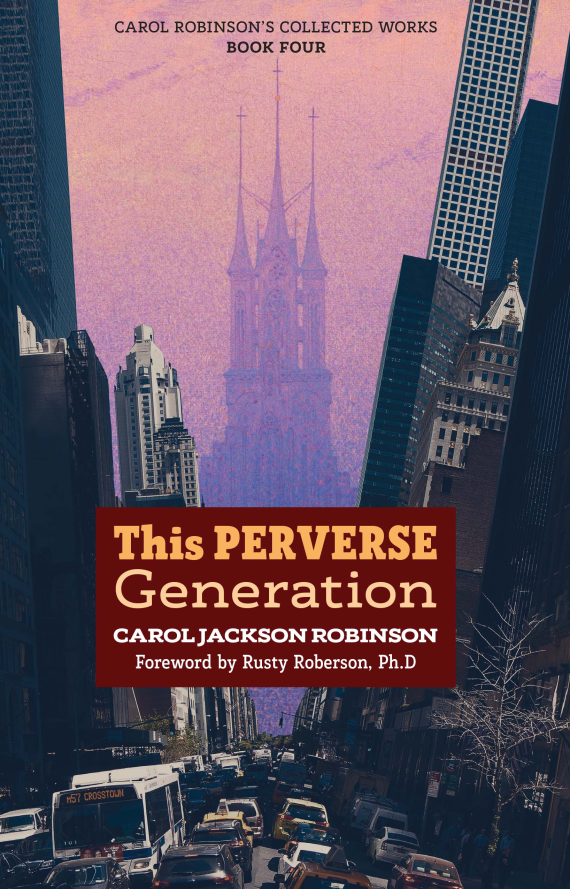
  • This Perverse Generation (Book 4/Collected Works)...

    Carol Jackson Robinson | Foreword by Rusty Roberson, Ph.D.

    Book 4 of Carol Robinson's Collected Works. It was originally published in 1949 and then in 2007. Foreword by Rusty Robe...

    View Book →
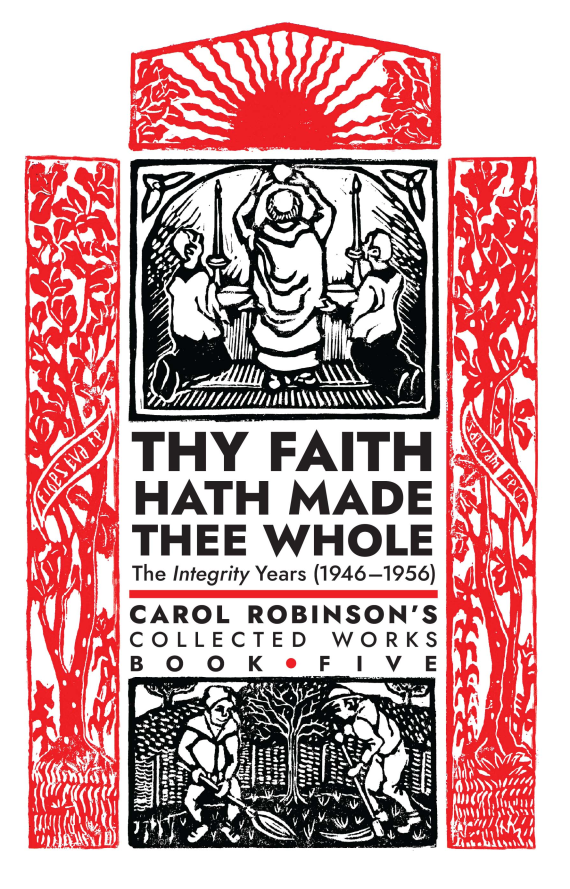
  • Thy Faith Hath Made Thee Whole (Book 5/Collected Works)...

    Carol Jackson Robinson | Foreword by Alan Fimister, Ph.D.

    Carol Jackson Robinson Collected Works · Book 5 Thy Faith Hath Made Thee Whole The Integrity Years · 1946–1956 ...

    View Book →

    Stay in Touch

    Receive updates on new releases, special offers, and notable developments from Arouca Press.