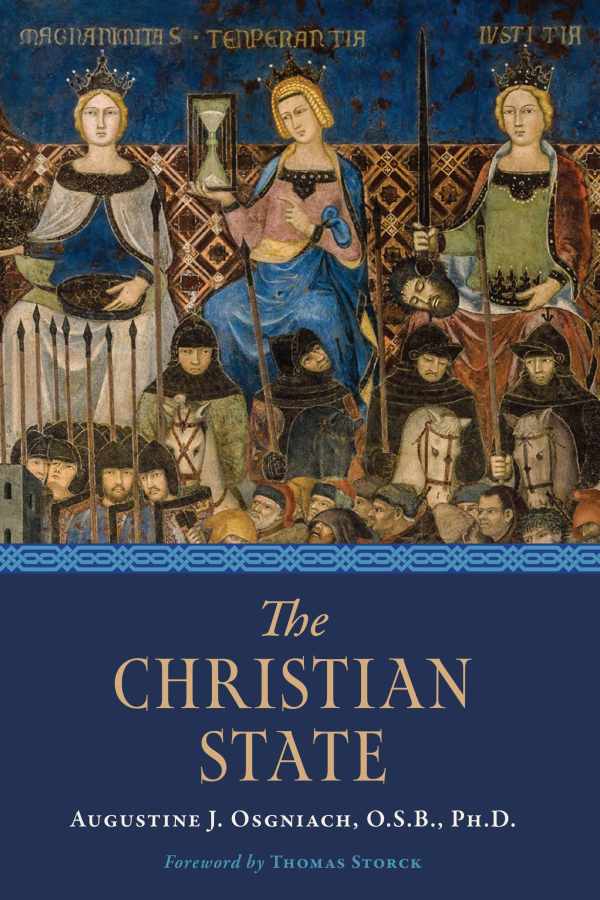
-570x889.png "Foundations of a Catholic Political Order (Second Edition)")
Foundations of a Catholic Political Order (Second Edition)...
In the last few years more and more Catholics have begun taking seriously Pope Leo XIII's teaching on the relationship b...
View Book →


XIII Books
Augustine J. Osgniach, O.S.B., Ph.D.
Professor of Philosophy, St. Martin’s College · Foreword by Thomas Storck
A rigorous Catholic political philosophy of the state, civil authority, natural right, liberty, the family, and the relation of Church and State.
Dedicated to Christ the King of all ages, nations, races, and tongues.
Catholic Political Philosophy
A defense of the state as a natural society ordered to the common good and grounded in human nature.
Authority and Right
A study of civil authority, natural law, positive law, justice, liberty, and political obligation.
Church and State
A clear treatment of the family, education, religion, the Church, and the duties of civil society.
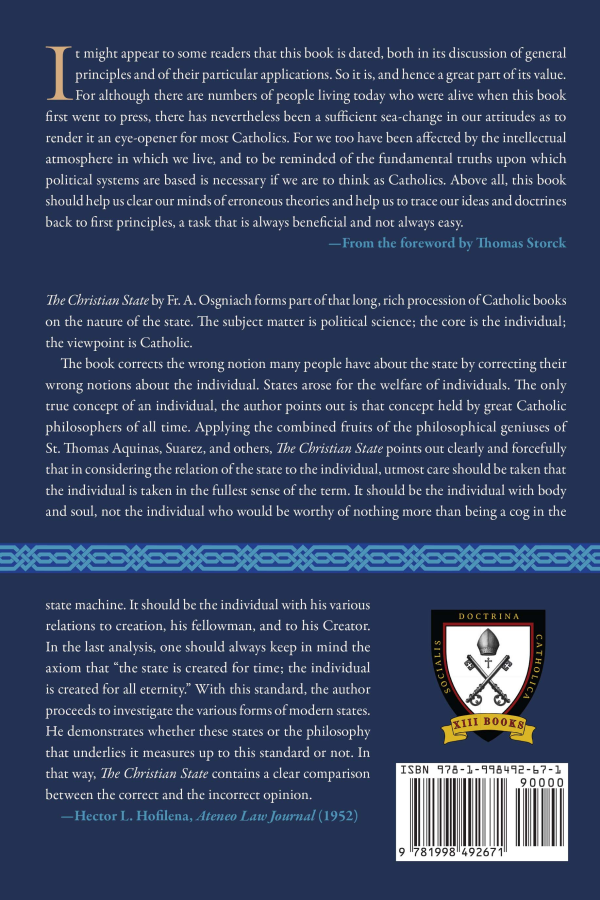
It might appear to some readers that this book is dated, both in its discussion of general principles and of their particular applications. So it is, and hence a great part of its value. For although there are numbers of people living today who were alive when this book first went to press, there has nevertheless been a sufficient sea-change in our attitudes as to render it an eye-opener for most Catholics.
For we too have been affected by the intellectual atmosphere in which we live, and to be reminded of the fundamental truths upon which political systems are based is necessary if we are to think as Catholics. Above all, this book should help us clear our minds of erroneous theories and help us to trace our ideas and doctrines back to first principles, a task that is always beneficial and not always easy.
—From the foreword by Thomas Storck
The Christian State by Fr. A. Osgniach forms part of that long, rich procession of Catholic books on the nature of the state. The subject matter is political science; the core is the individual; the viewpoint is Catholic.
The book corrects the wrong notion many people have about the state by correcting their wrong notions about the individual. States arose for the welfare of individuals. The only true concept of an individual, the author points out, is that concept held by great Catholic philosophers of all time. Applying the combined fruits of the philosophical geniuses of St. Thomas Aquinas, Suarez, and others, The Christian State points out clearly and forcefully that in considering the relation of the state to the individual, utmost care should be taken that the individual is taken in the fullest sense of the term.
It should be the individual with body and soul, not the individual who would be worthy of nothing more than being a cog in the state machine. It should be the individual with his various relations to creation, his fellowman, and to his Creator. In the last analysis, one should always keep in mind the axiom that “the state is created for time; the individual is created for all eternity.”
With this standard, the author proceeds to investigate the various forms of modern states. He demonstrates whether these states or the philosophy that underlies it measures up to this standard or not. In that way, The Christian State contains a clear comparison between the correct and the incorrect opinion.
—Hector L. Hofilena, Ateneo Law Journal (1952)
Thomas Storck’s new foreword emphasizes the continuing importance of this work: the state is not an artificial contract formed by isolated individuals, nor is it an idol before which the person and family must disappear. It is a natural society ordered to man’s true end.
For readers confused by modern political categories, The Christian State offers a disciplined Catholic alternative: neither liberal atomism nor totalitarian absorption, but the political order understood in light of nature, justice, authority, and the common good.
Society and the State
The natural basis of society, the family, political order, and the state as a necessary society.
Civil Authority
The origin, basis, purpose, and limits of legitimate authority.
Totalitarianism
A critique of the state that claims absolute autonomy and absorbs the rights of persons and families.
Right and Morality
Natural right, positive right, law, justice, and the moral foundation of political life.
Liberty and Equality
Liberty of thought, speech, conscience, religion, juridical equality, economic equality, and education.
The Family and the Church
Marriage, education, parental rights, the Church as a perfect society, and the relation of Church and State.
“The state is created for time; the individual is created for all eternity.”
The Common Good
The true purpose of civil society and the measure of political authority.
Natural Law
The moral foundation of right, authority, duty, and civil obligation.
Human Dignity
The individual person is created for eternity; the state exists in time.
Family Rights
The family is not a creature of the state but a natural society with its own rights.
Social Order
Political life must be ordered by truth, morality, justice, and the end of man.
Christ the King
The book’s dedication places political order under the kingship of Christ.
XIII Books
Arouca Press’s imprint for serious Catholic works of enduring intellectual and cultural importance.
XIII Books
The Christian State
Augustine J. Osgniach, O.S.B. · Foreword by Thomas Storck
A systematic Catholic treatment of society, civil authority, right, liberty, the family, and the relation of Church and State.
A complete survey of Catholic political philosophy, from first principles to the practical questions of right, liberty, property, education, and religion.
Foreword (2025)
Foreword (1943)
Author’s Preface
I.
Part I. Erroneous Theories of the State
1. The Theories of Social Contract. 2. The Theory of Social Organism. 3. The Theory of Social Anarchy.
Part II. Christian Philosophy of State
1. The Family a Natural and Necessary Society. 2. The State a Natural and Necessary Society. 3. Nature of the State.
II.
Part I. Erroneous Theories of Civil Power
1. Natural Theories. 2. Contractualist Theories.
Part II. Christian Theory
1. Civil Authority as a Principle of Unity. 2. Civil Authority as a Principle of Obligation. 3. Traditional Exposition. 4. The Ultimate Ground of Civil Authority.
III.
Part I. The Formation of the State and Its Elements
Part II. Nonacceptable Theories
1. Pufendorf. 2. Scholastic Contractualism. 3. C. L. Haller’s Theory.
Part III. The Natural-Juridical Theory
IV.
Part I. Erroneous Theories
1. Liberalistic Conceptions. 2. Absolutistic Conceptions.
Part II. Christian Teaching
1. Purpose of the State. 2. Function of the State.
The opening chapters establish the first principles: society is natural, authority is moral, and the state exists for the common good.
V.
Part I. Exposition
1. From Liberalism to Totalitarianism. 2. Philosophical Sources of Totalitarianism. 3. Totalitarian State Defined.
Part II. Refutation
1. The State Not Absolutely Autonomous. 2. The State Not the Absolute Foundation of Right. 3. Totalitarianism Destructive of Individual and Family Rights.
VI.
Part I. Erroneous Theories
1. Positivism. 2. Theories of Rousseau and Kant.
Part II. The Christian Philosophy of Right
1. The Ultimate Basis of Right. 2. Natural Right and Positive Right. 3. Right and Morality.
VII.
Part I. The Nature of Man
1. Pantheism. 2. Materialism. 3. Christian Philosophy.
Part II. Teleology and the Ethical-Juridical Order
1. The Fourfold Principle of Causality. 2. The Teleological Conception of the Universe. 3. The Nonteleological Conception of the Universe.
Part III. Man’s Place in the Universe
VIII.
Part I. The Right to Life
1. Self-Defense. 2. Suicide. 3. Dueling. 4. Lynching. 5. Euthanasia. 6. Capital Punishment.
Part II. The Right to Private Property
1. The Nature of Ownership. 2. The Congruity of Ownership.
Part III. The Necessity of Private Property
1. Private Property Necessary to Man. 2. Private Property Necessary to Society. 3. The Social Nature of Ownership.
Part IV. The State and Ownership
1. State and Poverty. 2. The Dignity of Labor. 3. The Factors That Determine a Just Wage.
Part V. The Right to Personal Liberty
IX.
Part I. Liberty
1. Liberty of Thought. 2. Liberty of Speech. 3. Liberty of Conscience. 4. Liberty of Religion. 5. Limits to Liberty. 6. Criminal Propaganda.
Part II. Equality
1. Juridical Equality. 2. Economic Equality. 3. Equality in Education.
X.
Part I. The Family
1. The Nature of the Family. 2. The Relation of the Family to the State.
Part II. Indissolubility of Marriage
1. Divorce. 2. The Sacrament of Matrimony. 3. Artificial Birth Control.
Part III. Education
1. State Monopoly of Education. 2. The Rights of the Church to Education. 3. The Rights of the Family to Education. 4. The Rights of the State to Education. 5. Education, Morality, and Religion.
XI.
Part I. The Church
1. A Divine Institution. 2. A Perfect and Necessary Society. 3. Juridical Person.
Part II. The Church and the State
1. Relation of State to Religion. 2. The Rights of the Church May Not Be Ignored by the State. 3. Relations Between Church and State. 4. Church and State Each Supreme in Its Own Sphere.
Part III. The Separation of Church and State
Part IV. Pre-eminence of the Church
The final chapters move from political principles to the concrete institutions that form Christian society: liberty, equality, family, education, religion, and the Church.
Bibliography
Appendix
1. History of Sterilization. 2. Nature of Sterilization. 3. The Purpose of Eugenics. 4. Sterilization Is Impractical. 5. Morality of Sterilization.
Index
Be the first to write a review for this product.
In the last few years more and more Catholics have begun taking seriously Pope Leo XIII's teaching on the relationship b...
View Book →
PAPERBACK NOW AVAILABLE TO CUSTOMERS (note the international shipping cost) XIII Books, Arouca Press’s new imprint de...
View Book →
His Reign Shall Have No End is a new introduction to Catholic Social Teaching (CST). Too often, this rich subject is red...
View Book →
XIII Books — An Imprint of Arouca Press ☧ ✠ ⚜ Papal Social Principles A Guide and Digest Thomas J. Harte, ...
View Book →
Receive updates on new releases, special offers, and notable developments from Arouca Press.