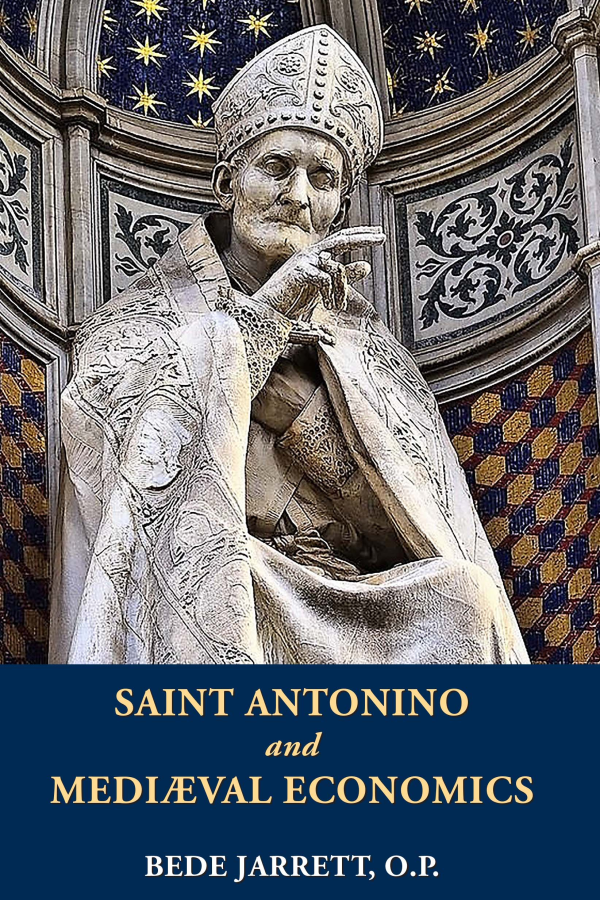
Saint Antonino and Mediaeval Economics
- Product Code: same
- Publication date: 2025
- Pages: 138
- Size: 5.5 x 8.5
$15.95
-
XIII Books Saint Antonino Dominican wisdom Economics and moral theology
Before economics became a discipline of abstraction, Saint Antonino treated wealth, trade, labour, price, poverty, and public order as moral questions. Jarrett’s biography restores a saint whose social teaching remains bracingly practical: money is for man, society is for justice, and commerce must remain under the law of God.
Florence · Dominican reform · Christian commerce · justice · labour · the common good
“To set up the standard of Justice, to lay the foundations of society on the laws of God, to make men look at economics through the eyes of Faith was the high endeavour of this great man.”
From the Introduction
✠ OVERVIEW ✠Saint Antonino and Mediæval Economics is Bede Jarrett’s 1914 life of Saint Antonino of Florence: Dominican reformer, Prior of S. Marco, Archbishop of Florence, moral theologian, and one of the Church’s most suggestive writers on social and economic questions.
Jarrett presents Antonino not as an antiquarian curiosity, but as a Christian statesman of the soul: a bishop who lived amid political unrest, class tension, plague, schism, commercial ambition, and Renaissance splendour, yet answered disorder with justice, charity, disciplined thought, and the moral law.
The book is especially valuable because it shows that Catholic social doctrine did not begin as a modern reaction to industrial capitalism. Long before the age of encyclicals, Saint Antonino was already asking how trade, money, property, wages, taxation, poverty, and public authority must be judged in the light of faith.
Republished by XIII Books, this volume belongs naturally to the imprint’s mission: to recover and publish works on politics, economics, the family, and the social order as seen through the Catholic tradition.
“Production is on account of man, not man of production.”
Saint Antonino’s social ideal
❦ WHY THIS BOOK MATTERS ❦It recovers a saint
Antonino is presented as a canonized Dominican archbishop whose sanctity was inseparable from practical government and social charity.
It corrects economics
The book insists that economics is never morally neutral: wealth, labour, trade, and taxation all stand under justice.
It clarifies wealth
Riches are good when rightly used, but they are not an end. They exist for the support of life, family, mercy, and the service of God.
It is timely
Jarrett wrote of a saint who answered unrest, corruption, poverty, and civic disorder with Christian clarity.
Three great themes
1. The moral meaning of economics
Jarrett shows Antonino judging commercial life as a moralist, not as an ideologue: the question is not merely what is profitable, but what is just.2. The social duty of charity
Antonino’s works of mercy were not sentimental gestures; they were organized, disciplined, civic, and grounded in the supernatural life.3. The Christian city
The book offers a vision of public life in which law, trade, education, hospitals, family, and political authority are all measured by God’s justice.✦ KEY QUESTIONS FOR READERS ✦What does it mean to look at economics “through the eyes of Faith”?
Can commercial life be governed by justice without becoming hostile to enterprise?
How should Catholics distinguish the lawful use of property from the disordered pursuit of riches?
What can a fifteenth-century Dominican archbishop teach a modern age about labour, wages, poverty, and the common good?
Is Catholic social thought primarily a modern response to industrial capitalism, or a much older inheritance?
Why does Jarrett present Saint Antonino’s economic teaching as both “reasonable” and “flamingly ideal”?
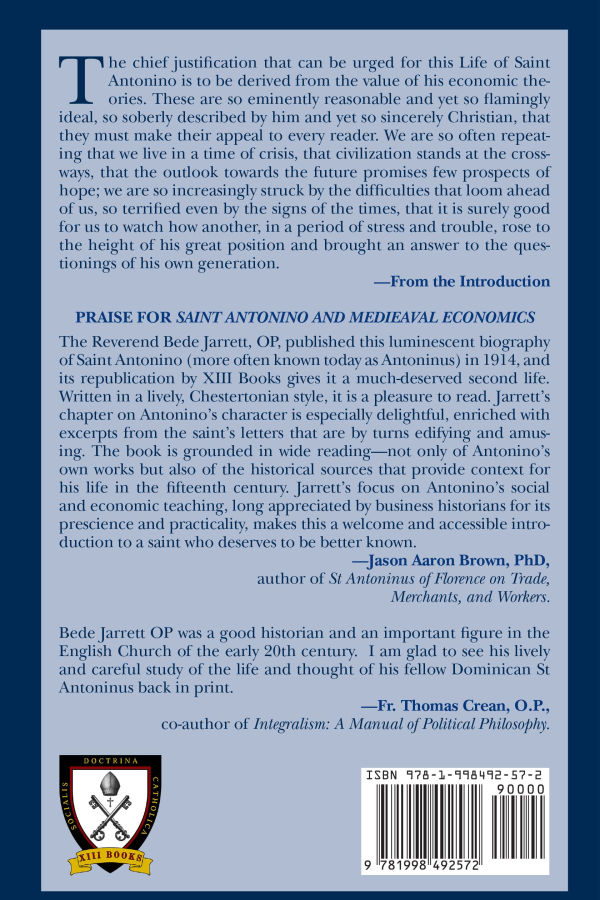
✠ FROM THE INTRODUCTION ✠“The chief justification that can be urged for this Life of Saint Antonino is to be derived from the value of his economic theories. These are so eminently reasonable and yet so flamingly ideal, so soberly described by him and yet so sincerely Christian, that they must make their appeal to every reader.”
“We are so often repeating that we live in a time of crisis, that civilization stands at the crossways, that the outlook towards the future promises few prospects of hope; we are so increasingly struck by the difficulties that loom ahead of us, so terrified even by the signs of the times, that it is surely good for us to watch how another, in a period of stress and trouble, rose to the height of his great position and brought an answer to the questionings of his own generation.”
✦ TABLE OF CONTENTS ✦Introduction
Chronicle of Contemporary Events to Show Unrest Gradually Quieting
Chapter I. The Night of Fore-being
Chapter II. Birth and Boyhood
Chapter III. The Young Dominican
Chapter IV. At S. Marco
Chapter V. The Good Archbishop
Chapter VI. His Social Labours
Chapter VII. His Social Ideals
Chapter VIII. His Other Literary Work
Chapter IX. His Character
Chapter X. Death and After
Bibliography
✦ BOOK DETAILS ✦Author
Bede Jarrett, O.P.
Imprint
XIII Books
An Imprint of Arouca PressOriginal publication
1914
Publication date
2025
Pages
138
ISBN
978-1-998492-57-2
A XIII Books recovery of Catholic social wisdom
This volume belongs with the works Catholics need when they want more than commentary on the modern crisis: it returns to a saint, a city, and a tradition in which economics remains answerable to justice, and justice remains answerable to God.
-
XIII Books Saint Antonino Dominican history Mediæval economics
Two endorsements commend Jarrett’s work as a lively, careful, and much-needed recovery of Saint Antonino: a saint whose economic thought deserves renewed attention in the Catholic social tradition.
lively biography · Dominican scholarship · social teaching · justice and commerce
❦ ENDORSEMENTS ❦“The Reverend Bede Jarrett, OP, published this luminescent biography of Saint Antonino (more often known today as Antoninus) in 1914, and its republication by XIII Books gives it a much-deserved second life. Written in a lively, Chestertonian style, it is a pleasure to read. Jarrett’s chapter on Antonino’s character is especially delightful, enriched with excerpts from the saint’s letters that are by turns edifying and amusing. The book is grounded in wide reading—not only of Antonino’s own works but also of the historical sources that provide context for his life in the fifteenth century. Jarrett’s focus on Antonino’s social and economic teaching, long appreciated by business historians for its prescience and practicality, makes this a welcome and accessible introduction to a saint who deserves to be better known.
—Jason Aaron Brown, PhD
author of St Antoninus of Florence on Trade, Merchants, and Workers.“Bede Jarrett OP was a good historian and an important figure in the English Church of the early 20th century. I am glad to see his lively and careful study of the life and thought of his fellow Dominican St Antoninus back in print.
—Fr. Thomas Crean, O.P.
co-author of Integralism: A Manual of Political Philosophy.✠ WHAT THE PRAISE EMPHASIZES ✠A recovered saint
The endorsements stress that Saint Antonino deserves to be far better known.
A lively style
Jarrett’s biography is praised as lively, careful, readable, and even Chestertonian.
Economic insight
The praise highlights Antonino’s social and economic teaching as practical, prescient, and accessible.
Dominican continuity
Fr. Crean places Jarrett within the wider English Dominican tradition.
A much-deserved second life
These endorsements point to the value of the republication: a lucid Dominican biography, a recovered saint, and a work of Catholic social thought that speaks directly to the moral questions of economic life.

Reviews (0)
Be the first to write a review for this product.