-570x889.png "The Church Speaks to the Modern World: The Social Teachings of Leo XIII")
The Church Speaks to the Modern World: The Social Teachings of Leo XIII...
.leo-page { --leo-red: #7b191d; --leo-dark: #252321; --leo-muted: #6f6962; --leo-gold: #ad9270; ...
View Book →


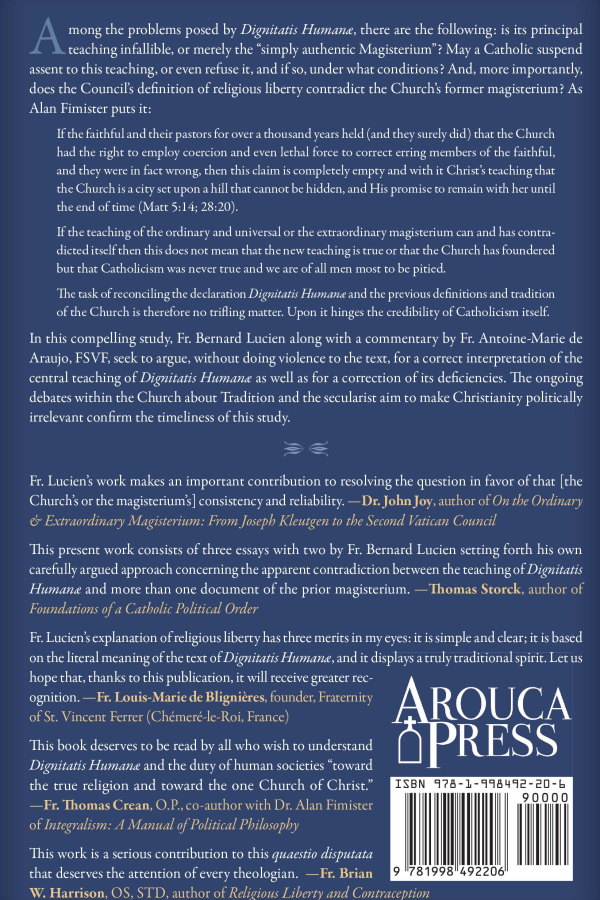
Among the problems posed by Dignitatis Humanæ, there are the following: is its principal teaching infallible, or merely the “simply authentic Magisterium”? May a Catholic suspend assent to this teaching, or even refuse it, and if so, under what conditions? And, more importantly, does the Council’s definition of religious liberty contradict the Church’s former magisterium? As Alan Fimister puts it:
If the faithful and their pastors for over a thousand years held (and they surely did) that the Church had the right to employ coercion and even lethal force to correct erring members of the faithful, and they were in fact wrong, then this claim is completely empty and with it Christ’s teaching that the Church is a city set upon a hill that cannot be hidden, and His promise to remain with her until the end of time (Matt 5:14; 28:20).
If the teaching of the ordinary and universal or the extraordinary magisterium can and has contradicted itself then this does not mean that the new teaching is true or that the Church has foundered but that Catholicism was never true and we are of all men most to be pitied. The task of reconciling the declaration Dignitatis Humanæ and the previous definitions and tradition of the Church is therefore no trifling matter. Upon it hinges the credibility of Catholicism itself.
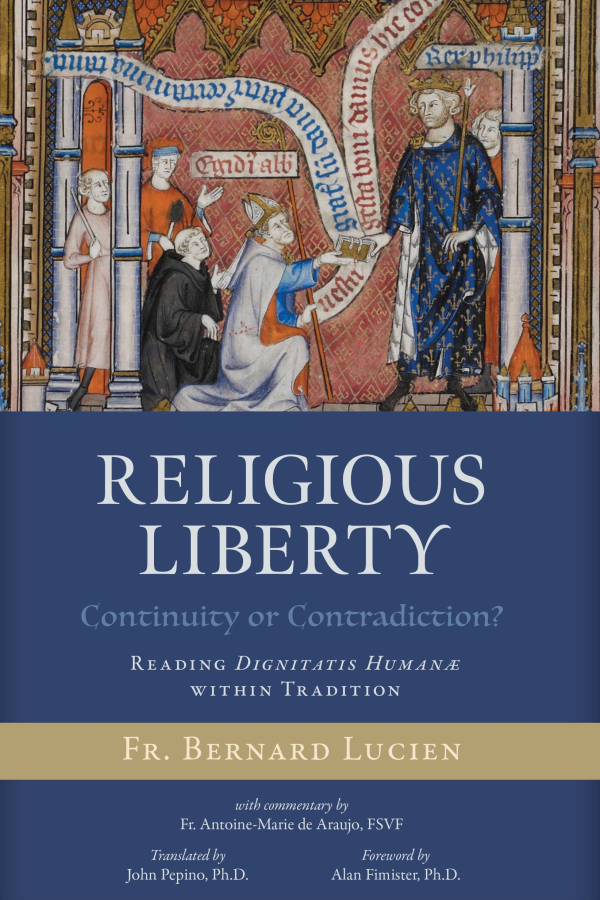
In this compelling study, Fr. Bernard Lucien along with a commentary by Fr. Antoine-Marie de Araujo, FSVF, seek to argue, without doing violence to the text, for a correct interpretation of the central teaching of Dignitatis Humanæ as well as for a correction of its deficiencies. The ongoing debates within the Church about Tradition and the secularist aim to make Christianity politically irrelevant confirm the timeliness of this study.
Why this book matters
The question is not merely political. It touches the reliability of the Magisterium, the meaning of conscience, the possibility of doctrinal development, and the relation of Catholic truth to public order.
The central difficulty
Does Dignitatis Humanæ contradict prior magisterial teaching, especially the condemnations associated with religious indifferentism?
Theological precision
Lucien distinguishes acting “according to conscience” from acting “as one wishes,” a key to the proposed resolution.
Tradition and development
The study argues for continuity while openly acknowledging ambiguity, deficiencies, and the need for further clarification.
A serious debate
A book for readers who want to understand the question rather than merely choose a partisan formula.
Weak, equivocal, dangerous, yet not erroneous in its main teaching.
Sedes Sapientiæ on Dignitatis Humanæ
Fr. Lucien and Fr. Araujo argue that it does not.
Translator’s Note on the central question
The expression “acting according to one’s conscience” changes meaning depending on whether one recognizes the human mind’s capacity to know exterior reality.
Fr. Antoine-Marie de Araujo, FSVF
This thesis not only avoids contradiction, but also explains the appearance of contradiction.
Conclusion
Foreword
Alan Fimister situates the stakes: the credibility of Catholicism and the reliability of the Magisterium.
Essay I
Vatican II and the “Hermeneutic of Continuity”
The crucial case of religious liberty.
Essay II
A Modest Follow-Up
Clarifications on religious liberty and Vatican II.
Commentary
Did Vatican II Contradict Prior Magisterium?
A solution proposed by Fr. Lucien.
Appendix
Dignitatis Humanæ
The Declaration on Religious Liberty, translated by Michael Pakaluk, Ph.D.
For traditional Catholics
This book speaks directly to readers troubled by the apparent contradiction between Dignitatis Humanæ and earlier teaching, without dismissing the gravity of the problem.
For theologians and serious readers
It offers a disciplined, text-centered contribution to an unresolved quaestio disputata, rooted in classical moral theology and the meaning of conscience.
Continuity
A defense of the Church’s consistency and reliability in her official teaching.
Clarity
A simple, text-based explanation of a notoriously difficult conciliar question.
Debate
A contribution to a living theological discussion that still demands careful study.
Tradition
A genuinely traditional reading of Dignitatis Humanæ and the problem of conscience.
Be the first to write a review for this product.
.leo-page { --leo-red: #7b191d; --leo-dark: #252321; --leo-muted: #6f6962; --leo-gold: #ad9270; ...
View Book →-570x889.png "Foundations of a Catholic Political Order (Second Edition)")
In the last few years more and more Catholics have begun taking seriously Pope Leo XIII's teaching on the relationship b...
View Book →-570x889.png "A Study of the \"Autonomous\" Episcopate")
✠ ✠ ✠ ✠ ✠ ✦ ✠ Arouca Press presents A Study of the “Autonomous” Episcopate Fr. Louis-Marie de Bli...
View Book →
Receive updates on new releases, special offers, and notable developments from Arouca Press.