
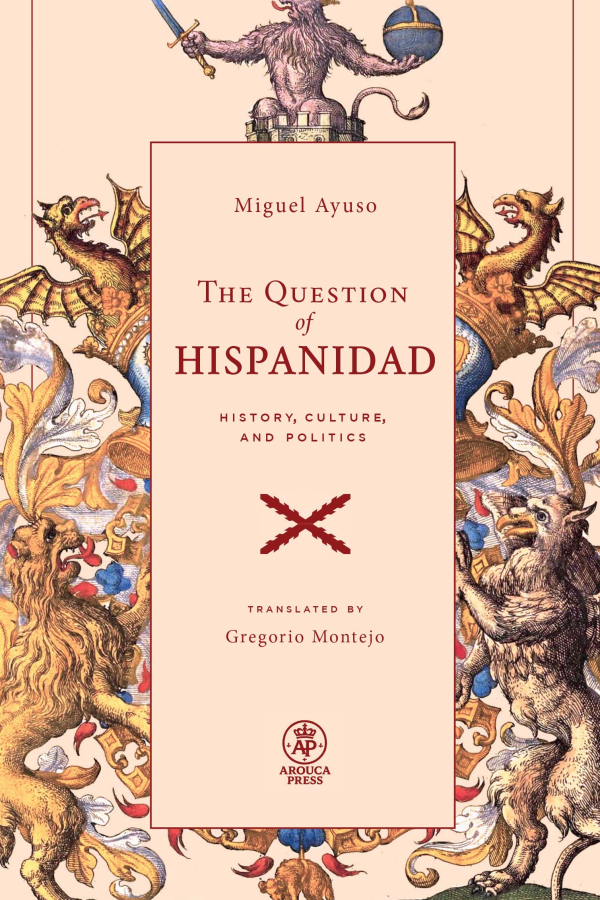
The Question of Hispanidad: History, Culture, and Politics
$14.95


- Product Code: tqoh
- Publication date: June 8, 2026
- Pages: 114
- Size: 5.5 x 8.5
-
Catholic political thought Hispanidad Counter-liberal vision Tradition and public order
These endorsements underscore the book’s central claim: Hispanidad is more than memory or sentiment. It is a civilizational inheritance with political meaning, theological depth, and contemporary relevance.
✠ CRITICAL ACCLAIM ✠“Because, contrary to what certain pompier Catholicism would have us believe, Hispanidad is not merely a cultural and spiritual concept. As Ayuso teaches us in this insightful work, it is also a political concept—alive today as a mustard seed in the hearts of patriots, ready to become a leafy tree tomorrow—that confronts the rationalist and Europeanising mentality that created modern states and also, of course, a new order that seeks to subsume them into monstrosities such as the European Union.
—Juan Manuel de Prada, writer, journalist, and literary critic
“This book is essential reading for anyone seeking to understand why ‘Europeanisation’ has always been a historical impossibility for the Hispanic world—and how Hispanidad, rightly understood, offers the only credible counter-weight to the nihilism of the present age.
—Alvino-Mario Fantini, Editor-in-Chief of The European Conservative and Managing Director of the European Documentation and Information Centre in Vienna, Austria
“Armed with the work of great Spanish historian Marcelino Menéndez y Pelayo, the intellectual heft of Fr. Manuel García Morente, and Ramiro de Maeztu—founder of Acción Española—Dr. Miguel Ayuso’s persuasive case for the integration of faith and politics presents a new path for an ethos of Hispanidad, perfectly timed for today when faith in Liberalism is losing steam, and Hispanidad can rise again as an authentic manifestation of the Church’s social doctrine.
—Richard Alemán i Ferrer, co-founder and editor-in-chief of The Distributist Review
❦ WHY THESE ENDORSEMENTS MATTER ❦Political significance
The endorsements recognize that Ayuso restores the political dimension of Hispanidad without reducing it to ideology.
Historical correction
Readers are invited to move beyond the habitual liberal reading of Spain and the Hispanic world.
Contemporary relevance
The book speaks directly to current questions of liberal exhaustion, civilizational identity, and Catholic social doctrine.
-
Reviews (0)
0 reviews
Be the first to write a review for this product.
Write a review
The modern liberal view usually presents the Hispanic world as a problem to be solved by secularization, constitutional imitation, and “Europeanization.” Ayuso reverses the question. He asks whether the apparent weakness of Hispanidad may in fact be the trace of a more ancient strength: Catholic unity, political plurality, local liberties, and a social order shaped by the Gospel.
A Catholic counter-reading of Spain, Spanish America, liberalism, and the modern State
The Question of Hispanidad introduces English-speaking readers to a tradition that is often misunderstood, caricatured, or reduced to nostalgia. Miguel Ayuso presents Hispanidad as a historical, cultural, and political reality rooted in the continuity of Christendom. Its sources are the Catholic faith, the plurality of the old Hispanic kingdoms, the juridical tradition of the fuero, and the conviction that public life must be ordered toward truth.
The book offers an important corrective for the English-speaking world. Much of the Anglophone imagination receives Spain and Spanish America through liberal historiography, the Black Legend, anti-Catholic assumptions, and the triumphalist story of “progress.” Ayuso gives readers another grammar. He treats the Hispanic world as a wounded continuation of the res publica christiana, then traces how liberalism, secession, nationalism, Europeanization, and Americanism fractured that inheritance.
This is a concise book with an ambitious argument. Hispanidad, rightly understood, is neither mere cultural sentiment nor an ethnic slogan. It is a Catholic political and civilizational question: whether the peoples formed by Spain’s historical mission can recover the principles that once joined faith, law, local liberty, common good, and public order.
A counter-view for English readers
The book challenges the assumption that liberal democracy, secular nationalism, and Europeanization are the natural destiny of the Hispanic world. It recovers the older Catholic claim: politics should serve a Christian order of peoples, laws, liberties, and common goods.
Hispanidad as Christendom
Ayuso reads Hispanidad as christianitas minor: a Baroque continuation of the older Christian commonwealth.
Catholic unity and fueros
The book joins the principle of religious unity to the concrete liberties of peoples, cities, and kingdoms.
Europe or Counter-Europe?
Ayuso contrasts Christendom with the modern European order of sovereignty, secularization, and rationalized politics.
The liberal rupture
The Spanish American secessions and liberal revolution appear as fractures in a Catholic political inheritance.
Ayuso’s thesis is sharp: the Hispanic world cannot be understood by measuring it against the liberal State. It must be read from within its own Catholic and juridical tradition.
The prevailing liberal account sees the Hispanic past as a burden: Catholic unity becomes intolerance; the Spanish Monarchy becomes colonial domination; the fueros become backward privilege; Europeanization becomes salvation; independence becomes simple emancipation. Ayuso presses the reader to ask whether this interpretive scheme is already loaded against the Catholic tradition.
Liberal reading
Spain must be secularized and Europeanized to become politically mature.
Ayuso’s reply
The Hispanic world has its own political form: Catholic, plural, juridical, and resistant to the modern State.
English-speaking importance
Readers formed by Whig, liberal, or Black Legend assumptions receive a disciplined counter-history.
Chapter 1
Hispanidad: From History to Prospective
Hispanidad is treated retrospectively, presently, and prospectively as a living ethos with political consequences.
Chapter 2
Hispanidad as Europe or Counter-Europe
The book examines the opposition between Christendom and the modern European political order.
Chapters 3–4
Maeztu and Morente
Ayuso studies two convergent paths toward Hispanidad: patriotic love and supernatural conversion.
Chapter 5
Hispanidad and the Res Publica Christiana
The final chapter confronts Spanish American liberal nationalism and the unresolved political problem of Catholics.
1. What does Ayuso mean by calling Hispanidad a continuation of Christendom?
2. Why does the book distinguish “Europe” from “Christendom”?
3. How do Catholic unity and the fuero correct modern assumptions about authority and freedom?
4. What did liberalism do to the political unity of the Hispanic peoples?
5. Why does Ayuso present Carlism as a distinctive political expression of the res publica christiana?
6. How should English-speaking Catholics revise the inherited liberal story of Spain and Spanish America?
Title
The Question of Hispanidad
Subtitle
History, Culture, and Politics
Author
Miguel Ayuso
Translator
Gregorio Montejo
Paperback ISBN
978-1-998492-76-3
Hardcover ISBN
978-1-998492-83-1