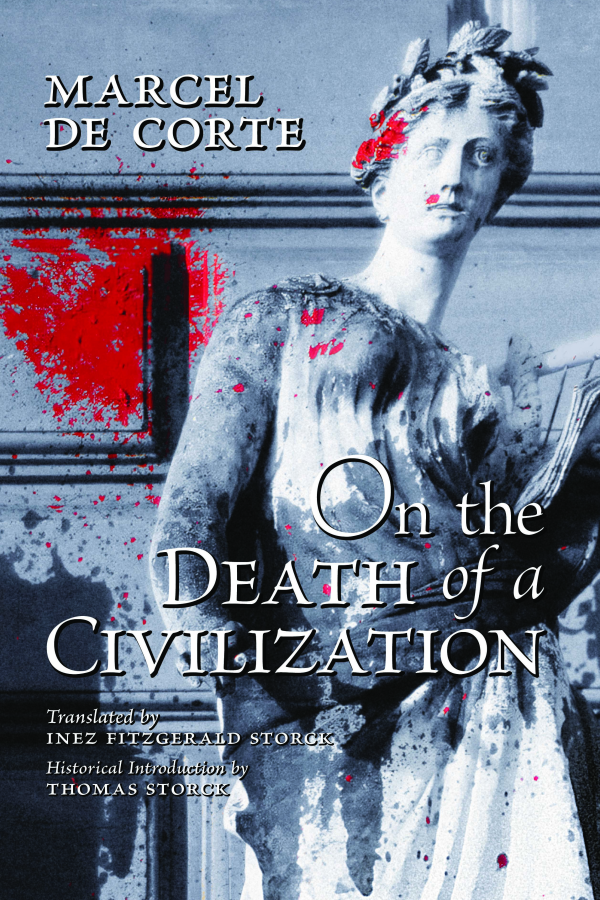
-570x889.png "Intelligence in Danger of Death")
Intelligence in Danger of Death...
✦ ✦ ✦ Intelligence in Danger of Death by Marcel De Corte · Translated by Brian Welter · Introduction by Miguel Ayu...
View Book →This is not merely a lament over decline. It is a metaphysical anatomy of cultural death: what happens when man is severed from nature, tradition, family, locality, work, worship, and the transcendent order by which civilization becomes humane.
spirit and life · politics and society · technology and collectivism · Christianity and modern civilization
“The distinctive characteristic of a true civilization is to bring together, organically, with unity in diversity, persons who without it would live as isolated individuals.”
Marcel De Corte
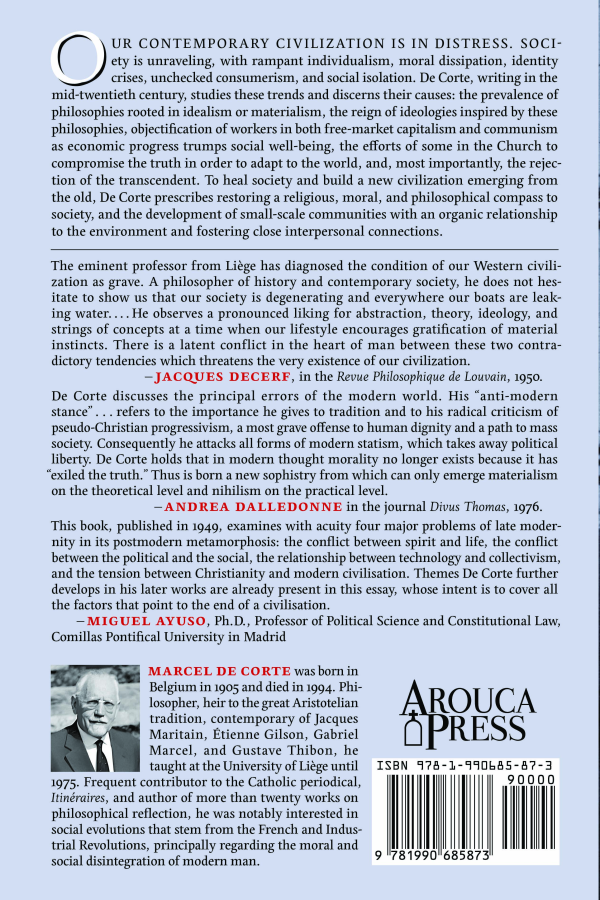
Our contemporary civilization is in distress. Society is unraveling, with rampant individualism, moral dissipation, identity crises, unchecked consumerism, and social isolation.
De Corte, writing in the mid-twentieth century, studies these trends and discerns their causes: the prevalence of philosophies rooted in idealism or materialism, the reign of ideologies inspired by these philosophies, objectification of workers in both free-market capitalism and communism as economic progress trumps social well-being, the efforts of some in the Church to compromise the truth in order to adapt to the world, and, most importantly, the rejection of the transcendent.
To heal society and build a new civilization emerging from the old, De Corte prescribes restoring a religious, moral, and philosophical compass to society, and the development of small-scale communities with an organic relationship to the environment and fostering close interpersonal connections.
It defines civilization
De Corte begins by asking what civilization is, not as an artifact, but as the living expression of man’s relation to reality.
It exposes uprooting
Modern man becomes abstract, ideological, and homeless when he loses the organic bonds of family, work, place, tradition, and worship.
It critiques mass society
The isolated individual and the all-absorbing state appear together when intermediate communities are weakened or destroyed.
It points to renewal
The remedy is not nostalgia, but a return to reality: small communities, moral order, religious truth, and the primacy of the concrete.
A book against abstraction
De Corte’s central insight is that a civilization does not die first in its institutions. It dies first in man: in the loss of his capacity to receive reality, live within real bonds, and recognize an order not of his own making.
The result is a civilization of slogans, plans, systems, propaganda, mass politics, and technological power: an abstract civilization whose poverty appears precisely in its ambition to manage everything.
Inside the volume
What is civilization? · the conflict between spirit and life · politics and social issues · technology and collectivism · Christianity and modern civilization · the possibility of restoration after civilizational collapse
Our civilization is we ourselves.
What is Civilization?
A civilization that despises tradition loses the vital reserves.
What is Civilization?
Everything will begin anew as small groups of people with mutual love rebuild an earthly civilization under the gaze of God.
What is Civilization?
The current crisis is essentially anthropological and, in the last analysis, metaphysical.
The Conflict between Spirit and Life
1. Spirit and Life
The modern spirit becomes abstract, ideological, and disincarnate; life, deprived of spirit, sinks toward instinct and mechanism.
2. Politics and Society
Political systems expand as real social bonds decay; the state grows where the living tissue of society has weakened.
3. Technology and Collectivism
Technical power promises mastery, yet often accelerates depersonalization, standardization, and the flight from reality.
4. Christianity and Modern Civilization
Christianity cannot be reduced to an instrument for saving a dying order; it saves what is eternal in man and opens civilization to God.
Historical Introduction — Thomas Storck
Introduction. What is Civilization?
1. The Conflict between Spirit and Life
2. The Conflict between Politics and Social Issues
3. Technology and Collectivism
4. Christianity and Modern Civilization
Conclusion
Author
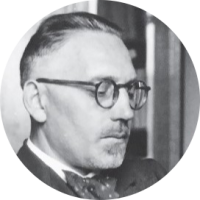
Marcel De Corte
Translator
Inez Fitzgerald Storck
Introduction
Thomas Storck
Original publication
1949
Paperback ISBN
978-1-990685-87-3
Cloth ISBN
978-1-990685-88-0
For readers of civilizational questions
De Corte writes for those who suspect that the crisis of the modern world is not merely political or economic, but spiritual, moral, and metaphysical. His concern is not the preservation of comfort, but the recovery of those conditions in which men can live as persons, communities can endure, and earthly life can remain open to God.
These endorsements and notices identify De Corte as a philosopher of history and contemporary society whose anti-modernism is not reaction but realism: a defense of truth, tradition, social order, and the dignity of the human person against the abstractions of ideology and mass society.
philosophy of history · Thomistic realism · anti-modernity · tradition · mass society
The eminent professor from Liège has diagnosed the condition of our Western civilization as grave. A philosopher of history and contemporary society, he does not hesitate to show us that our society is degenerating and everywhere our boats are leaking water….He observes a pronounced liking for abstraction, theory, ideology, and strings of concepts at a time when our lifestyle encourages gratification of material instincts. There is a latent conflict in the heart of man between these two contradictory tendencies which threatens the very existence of our civilization.
—Jacques Decerf
in the Revue Philosophique de Louvain, 1950.
De Corte discusses the principal errors of the modern world. His "anti-modern stance"...refers to the importance he gives to tradition and to his radical criticism of pseudo-Christian progressivism, a most grave offense to human dignity and a path to mass society. Consequently he attacks all forms of modern statism, which takes away political liberty. De Corte holds that in modern thought morality no longer exists because it has "exiled the truth." Thus is born a new sophistry from which can only emerge materialism on the theoretical level and nihilism on the practical level.
—Andrea Dalledonne
in the journal Divus Thomas, 1976.
This book, published in 1949, examines with acuity four major problems of late modernity in its postmodern metamorphosis: the conflict between spirit and life, the conflict between the political and the social, the relationship between technology and collectivism, and the tension between Christianity and modern civilisation. Themes De Corte further develops in his later works are already present in this essay, whose intent is to cover all the factors that point to the end of a civilisation.
—Miguel Ayuso, Ph.D.
Professor of Political Science and Constitutional Law, Comillas Pontifical University in Madrid
A grave diagnosis
De Corte is praised for seeing the crisis of civilization as serious, structural, and spiritual.
A critique of abstraction
The reviewers note his concern with ideology, theory, and concepts detached from reality and human nature.
An anti-modern stance
His anti-modernism is identified with tradition, liberty, truth, and opposition to pseudo-Christian progressivism.
A book of first principles
The book is commended for treating the deepest causes of civilizational dissolution.
A book recognized across decades
Readers have seen in De Corte’s work something more than historical commentary: a rigorous account of the forces that dissolve civilization when truth is exiled and man is cut off from the living sources of order.
Be the first to write a review for this product.
✦ ✦ ✦ Intelligence in Danger of Death by Marcel De Corte · Translated by Brian Welter · Introduction by Miguel Ayu...
View Book →
We are made to be happy, to experience eternal beatitude, the face-to-face vision of God. And we attain to this happines...
View Book →
Today's world is rocked by claims and counter-claims made by the most diverse groups. The result is ideological conflict...
View Book →
Insofar as the four cardinal virtues, prudence, justice, fortitude, and temperance, are remembered today, it is in a dis...
View Book →
Temperance has faded from modern consciousness as a virtue, relegated, when it is mentioned at all, to moderation in foo...
View Book →