

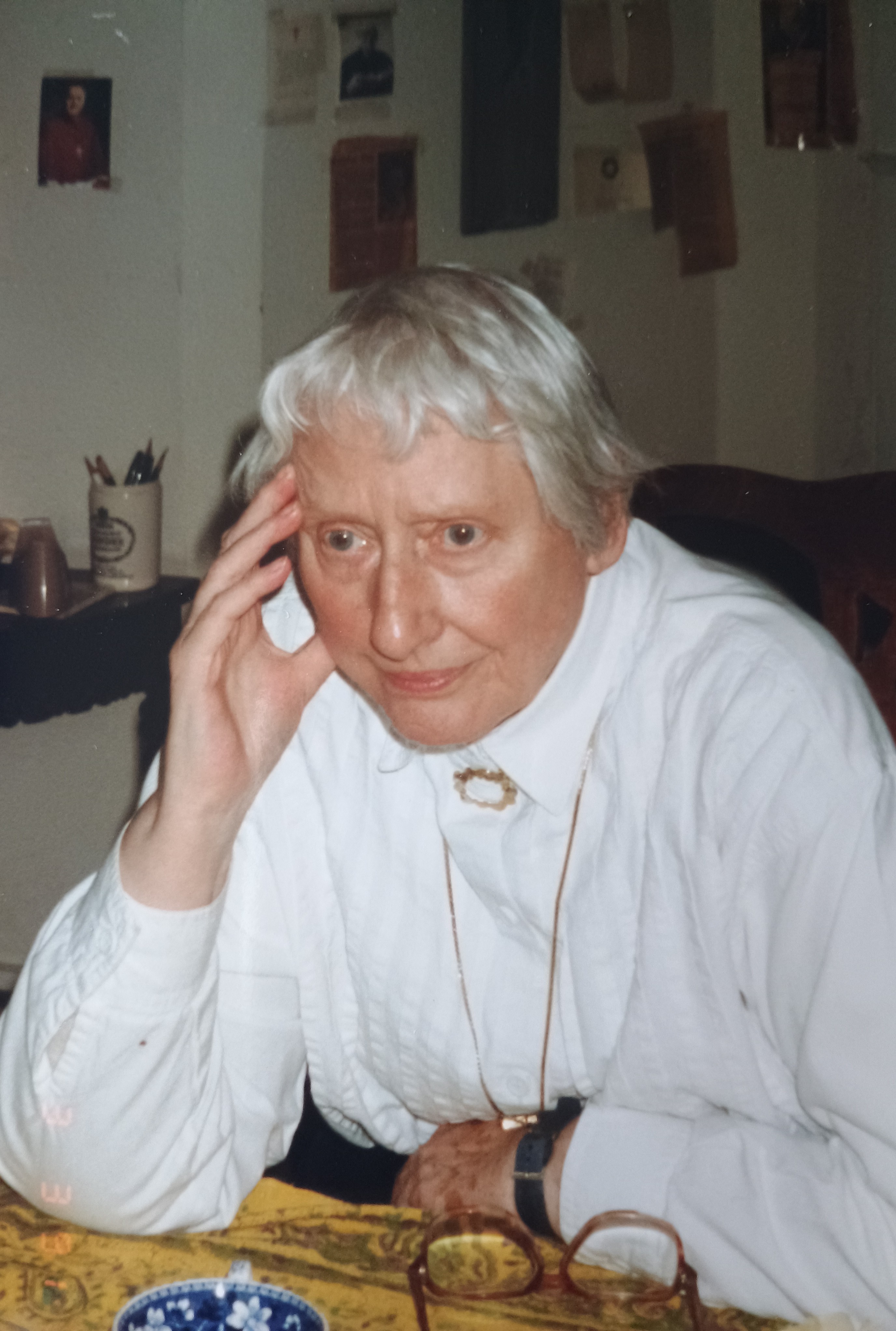
(Carol Robinson, 1991)
This is an unpublished essay by Carol Jackson Robinson written some time in the 1970s. It was written during her time as a contributor to The Wanderer. She was particularly disturbed by the catechetical programs used in the United States which she believed were contributing to a distortion of the faith.
The Catechetics of Self-Love
How does it happen that all our catechetical efforts aim at self-knowledge rather than at God-knowledge? Our children are always trying to understand themselves, to find out who they are. Why?
We are concerned here with the root errors of a metaphysical nature (because the root of these errors is metaphysical), and not to blame the catechists. Nevertheless, an inverted catechesis requires a similarly drastic change in those who teach it, and this factor cannot be ignored, so we must say something about it.
The old catechist was a nun, a priest, or a layman with special training; all of them directly accountable to the local pastor, and through him to the bishop, whose proper responsibility it is to teach and safeguard the Faith. The catechist had to know doctrine and be entirely orthodox. He used a catechism which explained doctrine faithfully. I don’t say that these conditions were always admirably fulfilled, but this was the norm.
Now all that is changed. Catechesis is the preserve of the positivist experts, the “professionals,” who do not have pastoral responsibilities. The actual teaching is done by laymen—more often laywomen—recruited locally. “Be a catechist,” the parish bulletin urges, “all you need is love.”
Is that all, just love? No doctrine?
Yes, that’s all, just love.
Is that because you are going to teach us doctrine, so we can teach it to the children?
No, there is no doctrine; it is just a methodology. We will show you how to do it and give you all the audio-visual and other aids you need. All you have to do is be loving with the children and docile to our instructions.
Thus it has come about in most parishes that no one who knows anything about the Faith and is orthodox can bear to teach or is allowed to teach. The new instructors will be programmed into the system for everything except love. Their great contribution is to lend the authority of motherliness to the undoing of discipline, the unlearning of truth, the naturalization of belief, and the beefing up of childish vanity. Without this touch the children themselves might resist.
So much for the catechists; now to the errors.
The Image of God in Us
The big error is about our likeness to God.
It is a familiar Catholic truth that we are made in the image and likeness of God. But in what does this image and likeness consist?
In this: that as God understands and loves Himself, so can we also (though differently and imperfectly, of course) know and love Him.
Our new theologians would state the likeness this way: As God knows and loves Himself, so also do we know and love ourselves.
The error is obvious, so let us return to a consideration of the truth.
The power of knowing and loving with which we know and love God is in our intellects. It is because we have intellectual, spiritual souls, that we, in contradistinction to the rest of corporeal creation, are made in the image and likeness of God, who is pure Spirit.
What our intellects naturally know (through the instrumentality of the senses) is the essences of corporeal things: the outside world which God made. From knowing this outside world, we rise to a knowledge of its Creator, either inferentially by common sense or more scientifically through philosophical reasoning (or in a higher way (still through Faith). And so we rise also to the actual likeness of God Who knows Himself. An analogical likeness, of course.
Our intellects are like blank tablets at first, possibly but not actually knowing anything. As our senses develop and furnish us with phantasms (which are quasi-spiritual reproductions of outside things in our imaginations), our low-grade intellectual souls abstract (shed light on) the potential intelligibility of the things themselves, making them actually intelligible. Then their essences are written on that blank tablet, which is activated thereby (it becomes the thing intentionally). So when the intellect becomes actual in this way, it can act, move itself, as it couldn’t before. It can reflect on itself and see itself knowing. This is the beginning of its understanding of itself, which in this life nevertheless is always indirect, through observations of the soul’s activities.
QUERY: But aren’t we directly conscious of ourselves, of our identity?
ANSWER: Yes, we are, but this consciousness comes with sense knowledge and is not different in kind from the self-consciousness that animals and infants have. A dog is conscious that it is he who is hurting, a baby that it is his hunger. It is not on this level that we image God or in this way that we understand ourselves.
So, to return. Our self-knowledge, then, is reflexive; it is an indirect and secondary understanding. We first know created things, and through them as their cause, the Creator. That’s why we are like God, in this natural and inferior aptitude we have for knowing Him through His creation.
The reason we have this natural aptitude for knowing God is because our souls are spiritual (immaterial). But they are the lowest grade of spiritual substances, and are also the forms of our bodies.
So their natural field of understanding is the intelligibility they can abstract from corporeal reality.
We Are Not Angels
With the angels this is not so. They are pure spirits, immediately intelligent and intelligible (intellectual knowledge goes with immateriality). So the first thing they know is themselves, and in knowing themselves they clearly see that God is their Creator and sustains them. You could not tell an angel he ought to find out who he is; he knows. He is a creature, wholly dependent upon God for his very being. He is a pure spirit of a certain rank in the hierarchy of angelic intelligence. He could not even deceive himself about his relative angelic status.
When we die, our spiritual souls are separated from our bodies and from the knowledge of outside things it brought them. But we can then know ourselves directly and not reflexively. Then we see our true spiritual, moral, and spiritual state and where we belong: in Heaven, Hell, or Purgatory.
The great metaphysical error we are considering, then, is in aiming first and directly at self-understanding, a thing which is proper to angels, but only to us when it is too late.
The Mistake About Self-Love
Now what about self-love?
God naturally loves Himself above all things. But if we were to love ourselves above all things, including God, our love would be perverse; because we are not, and God is, the highest good and supremely lovable.
But as God naturally loves Himself first and most, so also do we naturally love Him first and most (though imperfectly and differently because love follows knowledge and we know Him differently).
important to see how and why.
In natural things, what naturally belongs to another is principally and more strongly inclined to that to which it belongs than it is to itself. Now every creature in regard to its entire being naturally belongs to God (Who made it out of nothing). It is because angels see their total dependence on God that they could not love themselves more than God in the natural order. Even devils cannot and do not cease to love God, their Creator and Sustainer, more than themselves. It is true that they hate and blaspheme Him, but that is for other and accidental reasons—that He punishes them.
If we did not naturally love God more than ourselves it would follow that natural love would be perverse and that it would not be perfected but destroyed by supernatural charity. We would have to hate ourselves (not just our sins) in order to love God above all things as charity demands.
Moreover, it is true on every level that we do, or we ought to, love the whole to which we belong more than the part that we are.
A mother (old style) naturally and instinctively endangers her own life for the sake of her child. We see this in animals too. The natural maternal instinct favors the species (the whole) over the individual. On a lower level still, purely biological, a carrot will go to seed in a drought rather than use the remaining moisture to arrive at its own fullest development. So the fertility quotient of slum women rises above what it would be in healthier conditions.
In a different area, if the state were a natural society (instead of one built on nature by reason), its citizens would naturally lay down their lives in its defense. But since it is not a natural unity, only virtuous citizens do so willingly. (So Aristotle.)
And on a higher level still, it is the saints who die martyrs rather than deny the Faith. They love the Mystical Body of Christ, the Church, more than their own lives.
The Redirection of Nature
Nature cannot be destroyed; frustrated here, it seeks an abnormal outlet there.
Since we naturally love God more than ourselves, we cannot love ourselves first and foremost without deifying ourselves. When we sin, we usually prefer something else to God here and now—some pleasure that we can’t resist, for instance. Only out of pure malice here, or in Hell always (for there are no natural goods in Hell to attract us), is there a direct preference for self above God.
Yet this kind of pure love of self is being taught our children as a good thing. They are to see life as one long search for the ineffable knowledge of themselves. They are to concentrate on their highest possible development of their unique talents; not the development of their human nature which they share with others, but of their talents or peculiarities. They are to do their own thing, not their duty. They must decide all moral problems autonomously, each according to his special and fleeting circumstances, adjudicated by his own sacred “conscience.” (The real conscience is reason itself, making a practical moral judgment, which presupposes intellect, knowledge of universal norms and goals.) The alternatives are feeling or impulse or pride posing as conscience.
Now children are not monstrous enough to arrive at this state of self-love, which is directly opposed to the love of God, by their own bad will. They are taught it as a kind of personalist theology, as something they are growing into. Nevertheless it makes them into monsters of one kind or another.
It also isolates them from their natural communities. They can’t live with their parents, or stand any authority, or even the contradictions of their peers. But at the same time they still have need to associate with others (we are social animals), a desire to be good and do good and to be part of a whole which is greater than themselves.
As it is part of the new teaching to discredit and disparage the old and the past, the children have no basis for repudiating the errors they have been taught and returning to normalcy. They are patsies for the social revolution.
The Imposition of the New Order
After the children are trained in self-love and alienated from society, but hungering for it, they are told that they must love their neighbors more than themselves. It is the group that matters, or humanity, or the Church in the becoming. Anyhow, they are to be a part of a thing which is developing like a plant. They must get the feel of it and cooperate with the growth. The ideal now is to die to yourself, and your principles and your intellect, so as to merge with the group and commit yourself to its consensus-action, which you must not even try to understand. The one thing you don’t have to die to is your sins, because the new sins now bear only on resisting the new togetherness.
But this new selflessness is like that of the animals or the plants. When animals and plants die, their souls recede into the potentialities of matter. Prime matter is in potency to the reception of all forms. They become a part of a whole which doesn’t actually exist except under a succession of forms. It is a return to the slime of the earth, like evolution in reverse. It also has its similarities with Eastern mystics’ search for Nirvana. It is not only anti-Christian but also anti-human.
It all started with those epistemological errors; supposing themselves to be angels, men have come to make themselves like beasts. This is the metaphysical reality behind the cult of self in the new catechetics, and no amount of talk about the Whole Christ can diminish its powers of destruction. Makes it much worse, rather.
So this is why, and how, the Faith is being lost and our children spiritually ravished, by the very people whose duty is to instruct them in the truths of salvation.
Addendum: Perhaps we should carry this explanation just a little farther:
It is not really the business of catechesis to teach self-knowledge. This is the domain of spiritual direction, of the priest in the confessional. The power of the intellect to reflect on itself serves the soul’s self-direction toward God. As a matter of fact, the self-reflection of the conscience is inescapable. When we sin we pretend we don’t notice our duty; but afterwards the intellect reflects on itself and reproaches us. This is remorse of conscience. So self-reflection has its uses, but they are not in the province of catechetics.
However, since the epistemological errors of modern theology have turned us inwards toward ourselves instead of outwards towards God, we are automatically reduced to living and thinking on the sense level, because it is only there (as explained above) where we do have immediate consciousness of ourselves.
So when we try to see ourselves reflexively (for we still are intellectual although we refuse the intellect its proper objects), we resort to the imagination. Now it is a quite different thing to see ourselves as sinners (or as the subject of virtues and acts, as is done in the introspection of philosophical psychology which we omit to explore here) and to picture ourselves with the imagination. From not repenting our sins, we imagine that we are the helpless victims of injustice, or we see ourselves not as the disobedient Catholics we are but as martyrs in the cause of Church reform; as good when we are bad, as noble when ignoble, as wise when we are fools.
This imaginary self-image is the area of “consciousness raising,” where it is always open season for those who flatter us for the sake of the revolution. On this level self-love has no real truth to impede its unlimited exercise. The classical proud man was always looking over his own shoulder but usually at something real; we are always giving ourselves a new false image.
