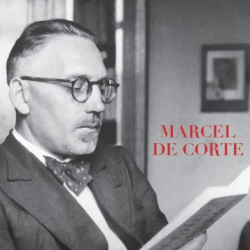
Marcel De Corte
Arouca Press presents
Marcel De Corte
Catholic Thomist · Philosopher of Reality · Critic of Modern Dis-society
Marcel De Corte remains one of the great Catholic Thomistic thinkers of the twentieth century, yet he is still little known in the English-speaking world. Arouca Press is the first publisher to translate his works into English, opening to new readers a body of writing marked by philosophical realism, moral seriousness, and a penetrating analysis of modernity.
On Marcel De Corte
The image of De Corte, obtained from his writings in Itinéraires, has remained with me, with his devastating analysis of: the epistemological reversal of modernity; the derangement of what is the product of this, the ‘homo rationalis’; the irredeemable crisis of civilization; the corrupting character of politics founded on the ‘religion of democracy,’ and the tragedy which was—and still is—the crisis of the post-conciliar Church. De Corte, of an unsurpassed intellectual mettle, professed philosophical realism which is in perfect accord with his anti-modernism. The denial of an uncreated order of values leads to modernism and ends by negating tradition, religion and morality.
—Miguel Ayuso
Professor of Political Science at the Comillas Pontifical University
Arouca Press is making available, for the first time in English, the major works of a thinker who judged the modern crisis from the standpoint of Aristotle, St. Thomas Aquinas, and Catholic realism.
Thomistic Realism
De Corte’s thought begins from the real: the created order, human nature, common sense, and the metaphysical structure of being.
Moral Order
His works on prudence, justice, fortitude, and temperance recover virtue as the living formation of intellect, will, and society.
Crisis of Civilization
De Corte diagnosed the modern collapse of organic society, the tyranny of abstraction, and the deformation of intelligence.
The Mind of Marcel De Corte
Marcel De Corte was not a system-builder in the modern sense. He was a realist: a philosopher of being, of common sense, of organic society, of the cardinal virtues, and of the Christian order. His critique of modern civilization is severe because it is rooted in a prior love: love for truth, for reality, for the created order, for the common good, and for the supernatural destiny of man.
His works examine the great modern inversions: intelligence severed from reality, society dissolved into mass collectivities, politics reduced to ideology, technique elevated above wisdom, and Christianity tempted to accommodate itself to the very civilization it is meant to judge and convert.
De Corte in His Own Words
I have not philosophized except via my reading of Aristotle and St. Thomas Aquinas.
Intelligence in Danger of Death
Introduction by Miguel Ayuso
Our civilization is we ourselves.
On the Death of a Civilization
“What is Civilization?”
Democracy and information go together. They are symmetrically unreal.
Intelligence in Danger of Death
Translator’s Foreword
The virtuous man is then attuned ... towards the true end of his existence.
The Four Cardinal Virtues
“Prudence”
For De Corte, the modern crisis is not first political, economic, or technological. It is metaphysical and moral: a rebellion against reality itself.
Arouca Press Editions
Available
Intelligence in Danger of Death
A prophetic study of propaganda, information, utopia, and the deformation of intelligence in modern mass society.
Available
On the Death of a Civilization
A philosophical diagnosis of civilization, tradition, organic society, technology, collectivism, and the Christian response to modern decline.
Arouca Press Edition
The Four Cardinal Virtues
A major volume gathering De Corte’s treatments of prudence, justice, fortitude, and temperance in light of Thomistic moral philosophy.
Forthcoming
Two-Volume English Reader
A forthcoming collection of De Corte’s essays from Itinéraires, bringing his Catholic social, political, and ecclesial criticism to English readers.
From the Forthcoming Two-Volume Reader
Arouca Press’s forthcoming two-volume English reader will gather a major selection of De Corte’s essays from Itinéraires, introducing English-speaking readers to his Catholic social, political, philosophical, and ecclesial criticism.
Civilization
“doubly and firmly rooted in the stability of both heaven and earth.”
“On the Influence of Contemporary Civilization on Catholicism”
Volume I
Transcendence
“divine transcendence has given way to ever-increasing immanence.”
“On the Influence of Contemporary Civilization on Catholicism”
Volume I
Christian Unity
“Truth was given first, and unity followed.”
“On the Influence of Contemporary Civilization on Catholicism”
Volume I
Conscience
“The socialization of conscience is the most splendid myth ever invented.”
“On the Influence of Contemporary Civilization on Catholicism”
Volume I
Wisdom
“Modern philosophy developed outside of natural truth.”
“A Few Reflections on the Moral and Political Work of Charles De Koninck”
Volume I
Intelligence
“To think correctly, one has to heal, and to heal, one has to think correctly.”
“A Few Reflections on the Moral and Political Work of Charles De Koninck”
Volume I
The Elites
“Moral knowledge, properly human knowledge, has regressed everywhere.”
“The Crisis of the Elites”
Volume I
Progressivism
“The cry of progressivism ... is not sursum corda, but forward.”
“Progressivism and the Will to Power”
Volume I
The Supernatural
“starving for the supernatural.”
“A Letter to Jean Madiran: On the New Mass”
Volume II
The Church
“The Church has entered the Dark Night of the senses and of the spirit.”
“A Letter to Jean Madiran: On the New Mass”
Volume II
The State
“Statism is the death of the state.”
“The Economy Turned Upside Down”
Volume II
Theology
“here is a theologian who actually does theology.”
“The Theological Meditations of Fr. Calmel”
Volume II
De Corte’s forthcoming English reader will show the breadth of his work: Catholic civilization, the crisis of the elites, progressivism, liturgy, political economy, theology, and the fate of intelligence in the modern world.
Why Read De Corte?
Reality
Because he restores the mind to what is, against ideology, image, propaganda, and abstraction.
Society
Because he sees society not as a contract or machine, but as an organic order of persons and communities.
Virtue
Because he treats the cardinal virtues as the living architecture of the soul and the common good.
Tradition
Because he understands tradition not as repetition, but as the living continuity that makes renewal possible.
The Church
Because his critique of secularization within Catholic life is inseparable from his defense of the supernatural.
Modernity
Because he anatomizes the modern world with rare clarity: its fantasies, powers, slogans, and false salvations.
The Arouca Press De Corte Library
Recovering one of the great Catholic Thomistic voices of the twentieth century for English-speaking readers.