
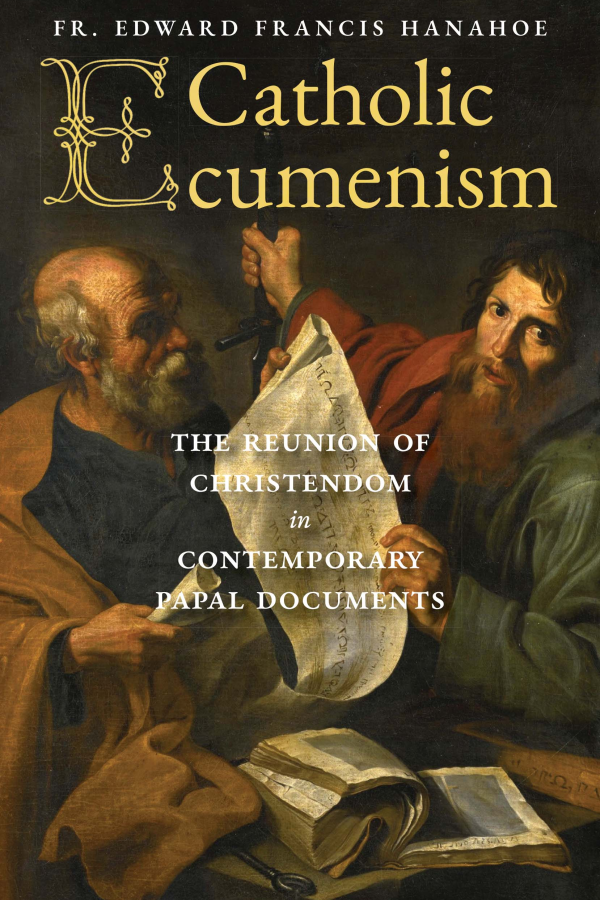
Catholic Ecumenism: The Reunion of Christendom in Contemporary Papal Documents
$19.95


- Product Code: ce
- Publication date: July 16, 2026
- Pages: 260
- Size: 5.5 x 8.5
-
Foreword Two Parts Five Chapters Appendix Essay Bibliography and Index
The contents reveal the disciplined construction of the book. Hanahoe begins with the existence of a Catholic ecumenism, moves to its nature, and then treats the goal of reunion, the point of departure, the path to unity, and the practical question of conversions.
Divine Revelation · Holy See · Unicity · Unity · Communion · Corporate Reunion · Conversion
❦ HOW TO READ THE CONTENTS ❦Front matter
The foreword prepares the reader for a preconciliar theological treatment of ecumenism, locating Hanahoe’s work within the Catholic University of America, the American Ecclesiastical Review, and the school of Msgr. Joseph Clifford Fenton.
Part One
The first part asks whether there is such a thing as a specifically Catholic ecumenism. Hanahoe answers by defining the term, clarifying the basic ideas, and then showing that the Holy See itself desired the reunion of separated Christians according to Catholic principles.
Part Two
The second part gives the theological architecture of reunion: the one Church founded by Christ, her visible unity, communion with the See of Peter, the concrete fact of separation, and the manner by which separated communities may return.
Appendix
The appendix, “Ecumenism and Conversions,” extends the dissertation’s argument into a practical question: how zeal for reunion relates to individual conversions and why authentic ecumenism cannot weaken missionary charity.
Scholarly apparatus
The bibliography and index make the volume useful for study: books, articles, and papal documents are gathered so the reader can trace Hanahoe’s claims back to their theological and magisterial sources.
✠ FRONT MATTER ✠xi
Foreword
1
PART ONE: Existence of a Catholic Ecumenism
❦ PART ONE ❦Introduction · p. 3
Criteria of Evaluation
The principles of reunion must be drawn from Divine Revelation and sanctioned by Divine Authority. This opening gives the reader the theological standard by which every later claim is judged.
Chapter One · p. 7
The Concept of Ecumenism
1. Basic ideas · p. 7
2. Papal sources · p. 20
This chapter defines the field of inquiry and distinguishes Catholic ecumenism from vague religious cooperation or doctrinal compromise.Chapter Two · p. 26
Desire of the Holy See
Hanahoe examines the Holy See’s positive desire for true Christian reunion and the principles that govern it. The chapter shows that the Catholic desire for unity is neither indifferentism nor sectarian refusal, but an act of charity governed by truth.
✦ PART TWO ✦p. 37
PART TWO: Nature of Catholic Ecumenism
Introduction · p. 39
Part Two moves from the fact that Catholic ecumenism exists to the theological question of what it is: its goal, starting point, and proper method.Chapter One · p. 41
The Goal of Reunion
1. The Unicity of the Church · p. 41
2. Unity of the Church · p. 47
3. Communion with the See of Peter · p. 64
The goal of reunion is concrete and visible: communion in the one Church of Christ, under the divinely instituted authority of Peter.Chapter Two · p. 80
The Point of Departure
1. The Fact of Separation · p. 80
2. Implications of Separation · p. 89
Hanahoe considers the theological reality of separation and the pastoral consequences for those born into communities separated from Catholic unity.Chapter Three · p. 104
The Way to Unity
1. The Basic Principle · p. 104
2. The Manner of Reunion · p. 112
Section 1: Corporate reunion in itself · p. 113
Section 2: Some applications · p. 125
The final chapter studies how unity is to be sought, especially through corporate reunion rightly understood and applied.❦ CLOSING MATERIALS ❦169
Summary and Conclusion
Draws the doctrinal argument together and restates the governing principles for reunion.
183
Appendix: Ecumenism and Conversions
A later essay clarifying how ecumenical work relates to conversions, missionary zeal, and Catholic witness.
207
Bibliography
Books · p. 207
Articles · p. 226
Papal Documents · p. 232235
Index
A practical guide for locating names, doctrines, papal texts, and theological themes.
242
About the Author
Places Fr. Hanahoe’s study within his priestly, theological, and Franciscan context.
✦ COMPLETE CONTENTS ✦Foreword xiPART ONE: Existence of a Catholic Ecumenism 1Introduction 3CHAPTER ONE: The Concept of Ecumenism 71. Basic ideas 72. Papal Sources 20CHAPTER TWO: Desire of the Holy See 26PART TWO: Nature of Catholic Ecumenism 37Introduction 39CHAPTER ONE: The Goal of Reunion 411. The Unicity of the Church 412. Unity of the Church 473. Communion with the See of Peter 64CHAPTER TWO: The Point of Departure 801. The Fact of Separation 802. Implications of Separation 89CHAPTER THREE: The Way to Unity 1041. The Basic Principle 1042. The Manner of Reunion 112Section 1: Corporate reunion in itself 113Section 2: Some applications 125Summary and Conclusion 169Appendix: Ecumenism and Conversions 183Bibliography: Books, Articles, Papal Documents 207Index 235About the Author 242 -
Endorsements
Catholic Ecumenism
The Reunion of Christendom in Contemporary Papal Documents
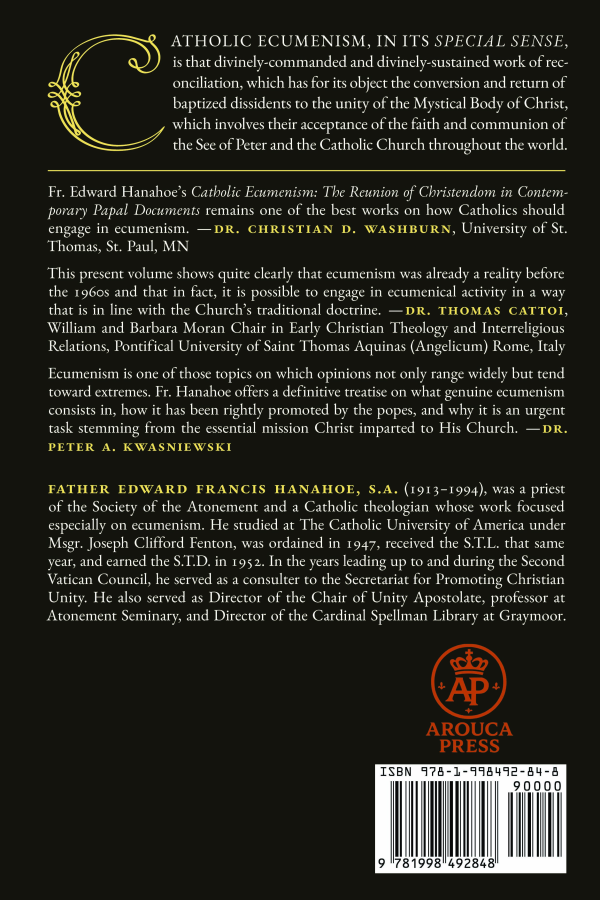
“Fr. Edward Hanahoe’s Catholic Ecumenism: The Reunion of Christendom in Contemporary Papal Documents remains one of the best works on how Catholics should engage in ecumenism. This study provides sound principles that govern Catholic ecumenism, deriving them from authoritative sources. As Fr. Hanahoe emphasizes—echoing the words of St. John Paul II—the ultimate goal of ecumenism is not merely a Christian federation, where each member retains his own opinions and private judgment, but the ‘full and visible communion in the same faith, the same sacraments, and the same apostolic ministry.’”
—Dr. Christian Washburn
University of St. Thomas, St. Paul, MN“Many contemporary Catholics believe that the Church’s ecumenical outreach only took off in the wake of the Second Vatican Council; not a few, in addition, have serious reservations about it, wondering whether it does not contribute to the watering down of the Church’s claims to possess the truth. This present volume shows quite clearly that ecumenism was already a reality before the 1960s and that in fact, it is possible to engage in ecumenical activity in a way that is in line with the Church’s traditional doctrine.”
—Dr. Thomas Cattoi
William and Barbara Moran Chair in Early Christian Theology and Interreligious Relations, Pontifical University of Saint Thomas Aquinas (Angelicum), Rome, Italy“Ecumenism is one of those topics on which opinions not only range widely but tend toward extremes—either toward dissolution of the uniqueness and necessity of the Catholic Church in favor of a broad confederation of Christians or toward flat denial that any such thing ought to exist or so much as be named. Happily, Fr. Hanahoe, writing from a position of preconciliar strength, offers a definitive treatise on what genuine ecumenism consists in, how it has been rightly promoted by the popes, and why it is an urgent task stemming from the essential mission Christ imparted to His Church. This work could serve as a complement to, and, in a way, corrective of, Unitatis Redintegratio and Ut Unum Sint. The author’s detailed discussions of the problems of Protestant disunity and the special cases of the Orthodox and the Anglicans are especially enlightening.”
—Dr. Peter A. Kwasniewski
-
Reviews (0)
0 reviews
Be the first to write a review for this product.
Write a review
Arouca Press · Theology
Catholic Ecumenism
The Reunion of Christendom in Contemporary Papal Documents
Fr. Edward Francis Hanahoe, S.A., S.T.L.
Overview
Catholic Ecumenism, in its special sense, is that divinely-commanded and divinely-sustained work of reconciliation, which has for its object the conversion and return of baptized dissidents to the unity of the Mystical Body of Christ, which involves their acceptance of the faith and communion of the See of Peter and the Catholic Church throughout the world.
Originally published in 1953, this work, under the guidance of Monsignor Joseph Clifford Fenton, the editor of The American Ecclesiastical Review, is an illuminating study on this often contentious but important issue in the Church.
About the Volume
Fr. Hanahoe studies Catholic ecumenism through the official documents of the Holy See, treating the existence and nature of Catholic ecumenism, the goal of reunion, the fact of separation, and the manner by which reunion is to be sought.
This edition also includes the appendix essay, “Ecumenism and Conversions.”
Book Details
| Title | Catholic Ecumenism |
| Subtitle | The Reunion of Christendom in Contemporary Papal Documents |
| Author | Fr. Edward Francis Hanahoe, S.A., S.T.L. |
| Original publication | 1953 dissertation, The Catholic University of America |
| Publication date | July 16, 2026 |
| Format | 260 pages · 5.5 x 8.5 · Paperback and hardcover |
