

-
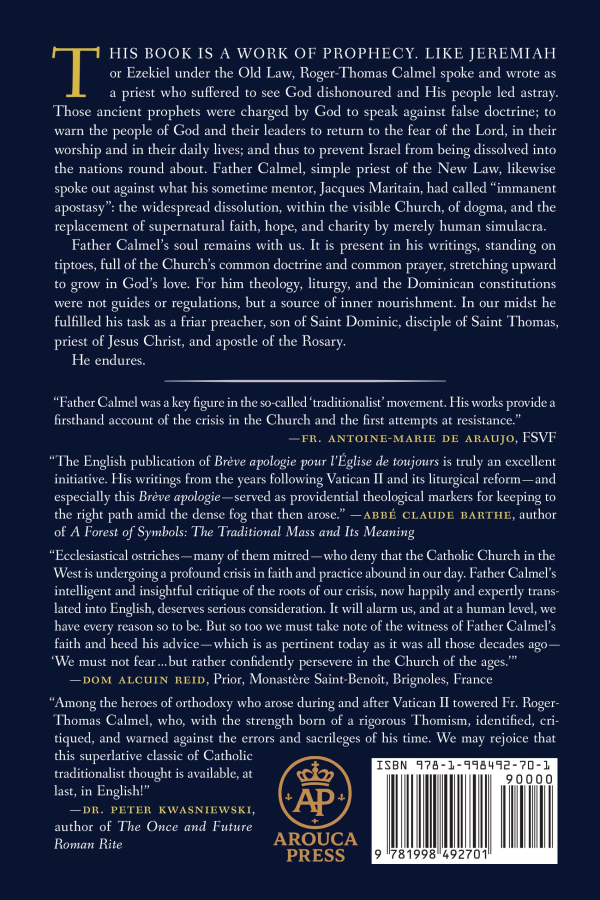
This book is a work of prophecy. Like Jeremiah or Ezekiel under the Old Law, Roger-Thomas Calmel spoke and wrote as a priest who suffered to see God dishonoured and His people led astray. Those ancient prophets were charged by God to speak against false doctrine; to warn the people of God and their leaders to return to the fear of the Lord, in their worship and in their daily lives; and thus to prevent Israel from being dissolved into the nations round about. Father Calmel, simple priest of the New Law, likewise spoke out against what his sometime mentor, Jacques Maritain, had called “immanent apostasy”: the widespread dissolution, within the visible Church, of dogma, and the replacement of supernatural faith, hope, and charity by merely human simulacra.
Father Calmel’s soul remains with us. It is present in his writings, standing on tiptoes, full of the Church’s common doctrine and common prayer, stretching upward to grow in God’s love. For him theology, liturgy, and the Dominican constitutions were not guides or regulations, but a source of inner nourishment. In our midst he fulfilled his task as a friar preacher, son of Saint Dominic, disciple of Saint Thomas, priest of Jesus Christ, and apostle of the Rosary.
He endures.
-
Born on May 11, 1914, and baptized on the 13th in Sauveterre-la-Lémance (Lot-et-Garonne), Father Roger-Thomas Calmel, a priest of the Order of Preachers, died on May 3, 1975. He was buried on May 5, the feast of the Dominican pope Saint Pius V, in the garden of the Teaching Dominican Sisters of Saint-Pré of the Immaculate Heart, in Brignoles (Var), where one may go to venerate his tomb.
The twentieth century saw the emergence of an impressive number of priests distinguished by their silence, their prudence, and their love of God. For many, they were a light in the night, a strength amid the storm, and a consolation in trial. Father Roger-Thomas Calmel was one of them.
The life of this great Dominican leads us through the terrible tempests of his time: the aftermath of the Great War, the condemnation of Action française, the Spanish Civil War, the rise of neo-modernism, the tragedy of Algeria, the Second Vatican Council and the upheavals that followed it, the liturgical reform of 1969, and the painful yet necessary choices demanded by fidelity.
Father Calmel was a great soul, though in a frail and often ill body; a religious endowed with a genuine sacerdotal nobility, a wisdom profoundly Thomistic—that is to say, both realistic and mystical—and a prophetic clarity of vision. And he preserved until his death the joyful, mischievous spirit of a peasant from Lot-et-Garonne.
(Source: P. Calmel, O.P. — Salve Regina)
-
“Father Calmel was a key figure in the so-called ‘traditionalist’ movement. His works provide a firsthand account of the crisis in the Church and the first attempts at resistance.” —Fr. Antoine-Marie de Araujo, FSVF
“The English publication of Brève apologie pour l’Église de toujours is truly an excellent initiative. His writings from the years following Vatican II and its liturgical reform—and especially this Brève apologie—served as providential theological markers for keeping to the right path amid the dense fog that then arose.” —Abbé Claude Barthe, author of A Forest of Symbols: The Traditional Mass and Its Meaning
“Ecclesiastical ostriches—many of them mitred—who deny that the Catholic Church in the West is undergoing a profound crisis in faith and practice abound in our day. Father Calmel's intelligent and insightful critique of the roots of our crisis, now happily and expertly translated into English, deserves serious consideration. It will alarm us, and at a human level, we have every reason so to be. But so too we must take note of the witness of Father Calmel’s faith and heed his advice—which is as pertinent today as it was all those decades ago—‘We must not fear…but rather confidently persevere in the Church of the ages.’” —Dom Alcuin Reid, Prior, Monastère Saint-Benoît, Brignoles, France
“Among the heroes of orthodoxy who arose during and after Vatican II towered Fr. Roger-Thomas Calmel, who, with the strength born of a rigorous Thomism, identified, critiqued, and warned against the errors and sacrileges of his time. We may rejoice that this superlative classic of Catholic traditionalist thought is available, at last, in English!” —Dr. Peter Kwasniewski, author of The Once and Future Roman Rite