
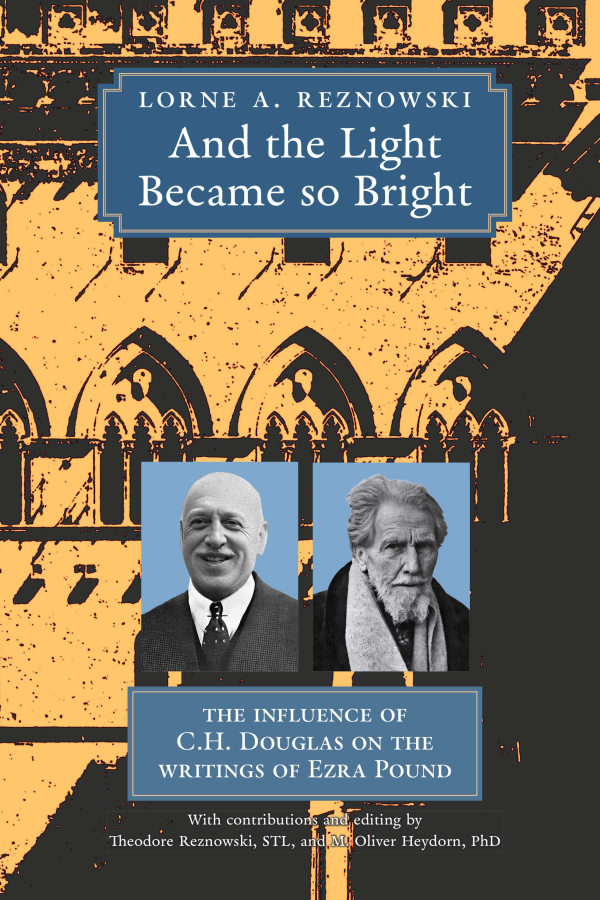
And the Light Became so Bright: The Influence of C.H. Douglas on the Writings of Ezra Pound
$26.95


- Product Code: albsb
- Publication date: 1/30/2026
- Pages: 490
- Size: 6.14 x 9.21
-
Reznowski reveals how C.H. Douglas’ Social Credit shaped Ezra Pound’s economic vision, poetic mission, and cultural critique. Without Douglas, much of Pound’s work remains opaque. Here lie the long-forgotten keys to economic freedom and the conditions for true art. —William Waite, director of Alternatives Exist: https://alternativesx.substack.com
-
Reviews (0)
0 reviews
Be the first to write a review for this product.
Write a review
The philosophy and the policy of C.H. Douglas had a profound influence on the writings of Ezra Pound. It is important to emphasize that this philosophy and policy were by no means limited merely to the question of monetary reform and economic considerations. C.H. Douglas has always insisted that monetary reform is but one aspect of Social Credit. He has constantly referred to Social Credit as the policy of a philosophy. He sees this philosophy as having its roots in a firm belief in the uniqueness and sacredness of the human individual. He has always insisted upon the Christian concept of the individual as opposed to the mass collectivism, which is advocated by various forms of materialistic messianism, e.g., Marxian Socialism.
C.H. Douglas regards the continuing warfare against the dignity, liberty, and sanctity of the individual and the move toward the centralization of power in industry, finance, and government to be the great crisis of our times. He sees the centralization of financial power as a key factor in this war upon the individual. This centralization of financial power is possible because of the complete domination of the existing monetary system by usury. The existing monetary and financial system is based upon a system of usury which in no way takes into account the economic facts of life.
Ezra Pound first met C.H. Douglas in The New Age editorial offices of A. R. Orage in 1918. He therefore met Douglas when Douglas's first articles on Social Credit were beginning to appear in The New Age. Because of his meeting and continuing contact with Douglas, Pound plunged into a life-time of research, one of the objects of which was to verify the truth of the Douglasite philosophy and proposed policy. The research carried him very deeply into the realm of world history and particularly monetary-economic history. This research took him on an intellectual periplum or voyage of discovery into the work and careers of Confucius, Malatesta, Cosimo de Medici, Leopoldo il terzo, and Pietro Leopoldo of the House of Habsburg-Lorraine, Napoleon, John Adams, Thomas Jefferson, Randolph of Roanoke, Abraham Lincoln, Benjamin Franklin, Duns Scotus, John Scotus Eriugena, St. Anselm, St. Ambrose, Alexander Del Mar, Thomas Hart Benton, Sir Edward Coke, Agassiz, etc. The purpose of The Cantos has been to record and chronicle the life-giving tradition based upon the dignity of the human individual and upon the philosophy of abundance. This philosophy of abundance is the distributist philosophy which prevailed whenever and wherever economic justice prevailed in history. This distributist philosophy was always connected with that monetary literacy and wisdom which opposed itself to usury. This distributist philosophy and policy of abundance is the very philosophy upon which the monetary-economic aspects of Douglasism are based. Hence Pound sees Douglasism as part of a much older thought-tradition or paideuma.
Opposed to this life-giving tradition is the death-dealing blight which manifests itself in collectivism, but whose very heart and soul is the system of usury. Pound sees usury as the great sin from which all other sins flow and upon which they feed. His interest in Usura and in the anti-usury paideuma throughout history can only be ascribed to the influence of C.H. Douglas, since it simply did not exist before Pound met Douglas. Pound's great interest and respect for medieval thought was encouraged by the fact that medieval thought equated usury with sodomy in that both were against the abundance of nature.
The policy and philosophy of C.H. Douglas provides a dominant theme for much of Pound's prose writing and provides the focal point or unifying theme for his great epic masterpiece, The Cantos. It is difficult to over-emphasize the impact of Douglas and Douglasism on the writings of Ezra Pound.
Why this book matters
This is a study of literature, monetary theory, cultural memory, and the battle over the meaning of civilization. It reads Pound’s economic concerns not as scattered eccentricities, but as part of a coherent encounter with Douglas’s Social Credit vision.
The Cantos
A sustained reading of Pound’s epic through the monetary-economic, historical, political, and philosophical influence of Douglas.
Social Credit
A careful presentation of Douglas’s monetary analysis, the National Dividend, the compensated price, and the larger philosophy beneath them.
Usury & culture
An exploration of Pound’s conviction that usury corrodes not only economic life, but art, history, language, and religion.
A hidden influence
A major recovery of a neglected line of influence running from Douglas to Pound’s prose, economics, and epic poetic architecture.
Social Credit is the policy of a philosophy.
C.H. Douglas
Monetary theory is worthy of study because it leads us to the contemplation of justice.
Ezra Pound
Money must cease to be master and become a servant.
C.H. Douglas
The credit of the nation belongs to the nation, and there is not the slightest reason why the nation should have to pay rent for its own credit . . . .
Ezra Pound
The state has credit.
Ezra Pound
The foundation
Douglas Social Credit, finance, the economy, and the philosophy beneath monetary reform.
Pound’s prose
The essays, letters, and broadcasts where Pound’s engagement with Douglas appears most directly.
Cantos I–LI
Early cantos read through monetary history, usury, power, and the emerging Douglasite framework.
Chinese & Adams Cantos
Confucian order, American monetary wisdom, political sovereignty, and the question of just credit.
Rock-Drill & Thrones
Late Pound, authority, judgment, economic order, and the search for civilizational light.
For readers of Pound
This volume offers a way into the intellectual architecture of The Cantos by tracing how Social Credit shaped Pound’s understanding of history, justice, art, and economic corruption.
For students of economics
It shows why monetary arrangements are not merely technical mechanisms, but moral, cultural, and political questions bound up with the dignity of the person.